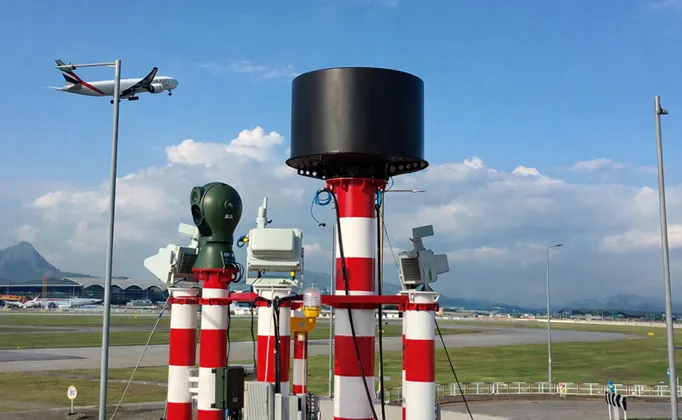
Airport Runway FOD Detection Systems, Risks, and Pan-Tilt Unit Applications
1. What is FOD—Foreign Object Debris?
FOD (Foreign Object Debris) is defined as an object being in an airport environment that does not belong there, present on the apron area, taxiways and runways. These could be the imperiled wreckage of airplane parts, vehicle rubble, or even natural items like rocks and pebbles. Some of the most pushed types of FOD in airport operations are for example:
Metallic objects (bolts, nuts, etc. of aircraft disassemblage)
Stones and gravel
Plastic and rubber materials
Baggage or packaging fragments
Bird carcasses or anything else biological
Because runways are critical areas for aircraft takeoff and landing, even very small foreign objects can pose a serious threat to flight safety. As a result, FOD control has become a vital part of modern airport safety management systems.

2. What Risks Does FOD?
2.1 Direct Influence on the Safety of Flight
The greatest threat FOD poses is the area damage it can cause to aircraft as:
Ingestion into the engine, which may result in a blade strike or power plant failure.
Damage to landing gear or tires, greater risk while taking off or touching down
-Damage by impact to the onboard sensors and antennas, leading to its use for flight control and navigation.
Tiny foreign objects are able to result in amplified impacts at high operating speeds with uncertain and possibly devastating safety impacts.
2.2 Implications for Airport Operations
Apart from flight safety, FOD has a major impact on airport in general:
Temporary Runway Closures a Cause of Disruptions in Regular Flight Traffic
Flight delays and cancellations cause a chain reaction across operations
Diminished airport efficiency and higher operating costs
According to long-term average values and recent investigations performed by various international institutions like Boeing, FAA or IATA the aviation industry world-wide looses about USD 4 billion/year in direct economic FOD-related damages mostly corresponding to aircraft damage and maintenance expenses. When the indirect costs are taken into account—such as flight delays, cancellations, aircraft substitutions, and fuel waste (caused by lesser efficiency or leaks), but also extra work in operations and administration—together they account for between USD 12 billion and USD 22.7 billion worldwide each year.

3. Why Traditional Manual Inspections Are No Longer Sufficient
Up until now, airports have been relatively dependent on manual inspection of the runway for FOD in order to remove it from service. Nevertheless, as airports grow larger and air traffic becomes denser, the deficiencies of manually scanning procedures have become apparent:
Limited inspection frequency, resulting in time gaps
Reduced efficiency during nighttime or adverse weather conditions
Random and unpredictable occurrence of FOD
Longer runways and larger operational areas significantly increase inspection workload
In today’s high-density airport operating environment, manual inspections alone are no longer capable of providing continuous, real-time FOD monitoring.
4. Mainstream Technologies for Airport Runway FOD Detection
To enhance runway safety, more airports are adopting automated FOD detection systems. The primary technology approaches currently include:
4.1 FOD Detection Systems Based on Radar For the detection of movable objects (like birds and human beings) on runways a variety of radar sensors are available.
Strong all-weather performance
Sensing of metallic as well as non-metallic objects
High system requirements and high deployment cost
4.2 Optical/Vision-Based FOD Detection Systems
Visual detection, and identification and classification of detected objects
Ideal for target validation and verification
Performance may be impacted by lighting and environmental conditions
4.3 Fusion of Radar and Optical Sensors
The radar (or other type of wide-area) detection with the optical sensor or systems for accurate verification is emerging as a most common scheme in today’s FOD detection world.
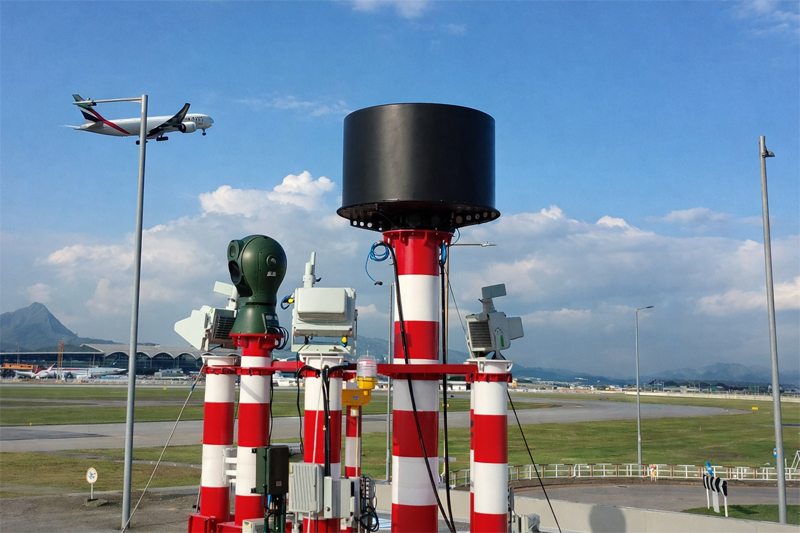
5. Pan tilt Units Are an Integral Component in FOD Detection Systems, But Why?
In intelligent FOD detection solutions, the pan-tilt unit (PTU) is far more than a simple mechanical structure. It serves as the critical execution component connecting “detection” and “visual confirmation.”
Core requirements of FOD detection systems include:
Wide-area coverage
Precise pointing capability
Fast response time
Long-term stable operation
Pan-tilt units form the mechanical backbone needed for all of these functionalities.
6. Typical Applications of Pan Tilt Unit in FOD Detection
6.1 High-zoom UHD cameras for identification of small objects
Objects that constitute FOD on airport runways are frequently small, have a wide spread distribution, and are located at long ranges. High zooming in ultra-high definition visible-light cameras mounted on pan-tilt units enable detailed observation of the runway surface from a long-distance, and small objects such as bolts, metal fragments, or stones can be detected and confirmed stably. Pan-tilt cameras extend surveillance coverage to cover far more ground with far fewer cameras, which can lower the total cost of buying an entire networked project.
6.2 360° Full-Area Scanning to Minimize Blind Spots
Airport runways are open environments where FOD can appear unpredictably.
With 360° continuous horizontal rotation and wide tilt angles, pan-tilt units can perform periodic scanning and automated patrols based on predefined strategies, achieving near-complete coverage of runway areas.
Well-planned scanning paths allow pan-tilt systems to:
Reduce monitoring blind spots
Increase abnormal object detection probability
Decrease reliance on manual runway inspections
6.3 Rapid Targeting Through Radar or Intelligent Algorithm Integration
When a radar system or intelligent algorithm detects a suspected FOD target, the pan-tilt unit can rapidly point to the target location based on coordinate data and automatically zoom in for visual confirmation, forming a closed-loop workflow of “detection – targeting – verification.”
7. Specific Technical Demands for Pan Tilt Unit in the FOD Applications
7.1 Repeat Positioning Accuracy to Provide Continuous Observation
Pan-tilt units are often required to reenter the same runway site so as to keep observing them continuously in FOD detection cases and crosschecking. Hence, reproducible performance is the most important criterion in this application. The high-quality ZIWIN TECH’s pan tilt unit can achieve the repeat positioning accuracy of 0.002°–0.005°.Even after a long-time operation, the system still can perform reliably and accurately to return to some targets for continued observing the small foreign object with high precision stare.
7.2 Long-Term Continuous Working and Environmental Adaptability
FOD detection systems in airports often work 24/7, placing high demands on PTUs such as:
Long-term operational stability
Wind and vibration resistance parties
Wide temperature tolerance
- Outdoor protection types as IP66/IP67
7.3) Not All PTU are Suitable for Airport FOD Application
It should be noted that the general surveillance pan-tilt units are immature for a long-term and large-area implementation, and may not satisfy the requirements of high precision, reliability, and volume to be used in an airport runway area. According, as a defect when using the pan-tilt device for FOD detection system in important part of the practical operation during system design and equipment selection need to use their own professional evaluation.
8. Future Trends in FOD Detection System
With the growth of airport traffic, FOD detection systems are being developed to:
Greater automation and intelligence
Multi-sensor fusion architectures
Further integration between airport operational systems
- Less reliance on manual intervention
9. Conclusion
Although FOD objects are often small, their impact on flight safety and airport operations is significant. Within modern airport safety frameworks, intelligent FOD detection systems are playing an increasingly important role. Stable, reliable, and high-precision pan tilt units have become indispensable core components of these systems.
 +86-15022658927
  sales@ziwincctv.com
  English
 français
 Deutsch
 Español
 italiano
 русский
 português
 العربية
 tiếng việt
 ไทย
ไทย Türkçe
 Pilipino
 עברי
עברי Afrikaans
 Polska