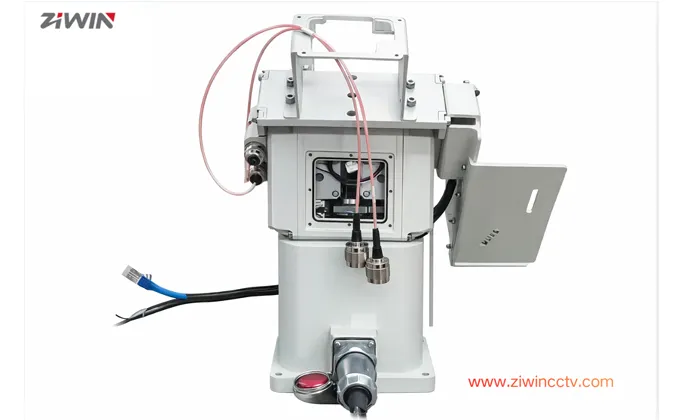
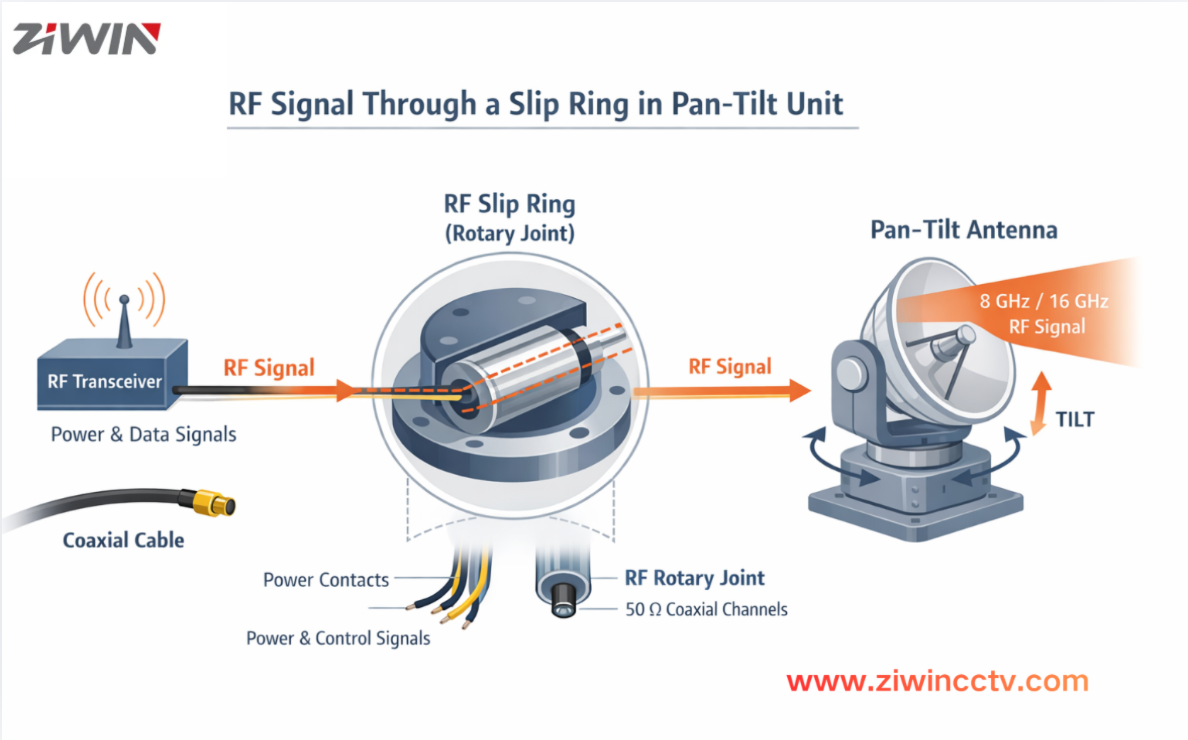
With the development of higher frequency, wider bandwidth and more complex function RF systems, dual channel RF pan tilt system become rampant in many fields,such as double antenna dual-channel communication channel radar primary link/secondary multi-polarization link system.. etc. In such systems, the pan tilt system has not only pointing control with high accuracy but also accommodates simultaneously and stably two high frequency RF signal transmissions during rotation. Signal transmission is supported by the slip rings, the most important part of this key work.
Dual-channel RF gimbals have more strict, complex requirements on slip rings compared with single-channel RF systems, and the main difficulties are as follows.
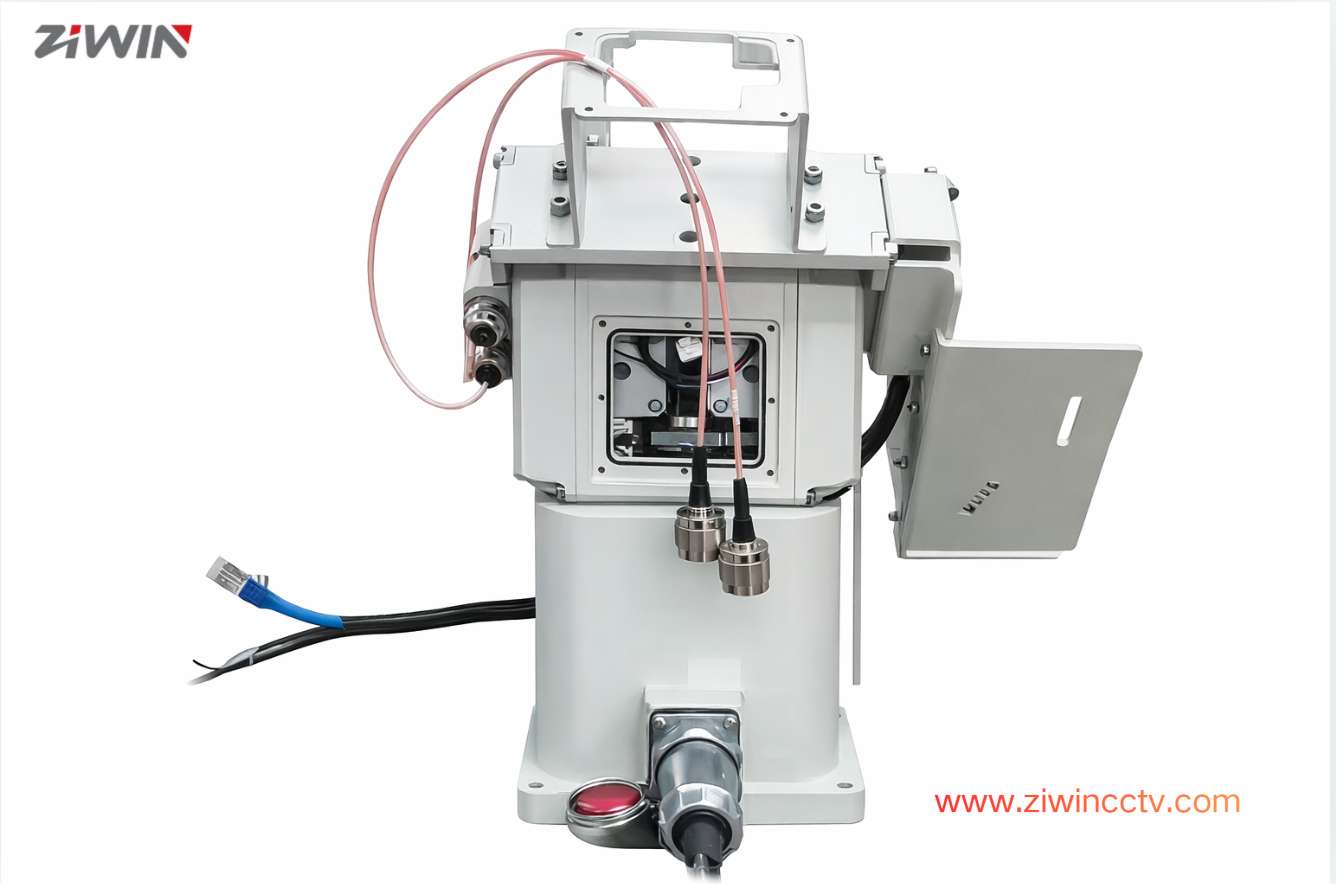
Independence and isolation of two RF signals
In the two-channel RF Pan Tilt system, it is required that a slip ring provides two RF signals. Such signals may operate in same or different frequency bands, with same or orthogonal polarisation scheme, and can be transmitted and received simultaneously. The major difficulty for slip ring is how to achieve the isolation between channels. Poorly-designed internal structures may cause RF channel crosstalk, signal coupling, and a worse SNR. At high frequencies, minor crosstalk can be multiplied at the system level degrading the quality of communication or resolution of radar. Thus, to overcome this drawback the slip ring in dual-channel RF pan tilt systems must provide a reasonable level of independence for both electrical and structural between two different RF signals.
Impedance matching and stability in a rotating frame
RF systems are highly sensitive to the impedance continuity and this demand is further increased in dual channel RF slip rings. In rotation, the slip ring also needs to work for keeping the characteristic impedance for each RF channel stable (e.g., 50 ) and not changing when rotating angle and speed vary. It must also prevent excessive reflections caused by mechanical tolerances, or the slightly varied contact conditions. The performance variation in one channel may cause the coordinated movement of the whole system, so that impedance stability of slip ring under rotating condition is a fundamental issue to be solved radially symmetric for dual-channel RF pan tilt unit.
Dual constraints of insertion loss and phase stability
SLIP RING REQUIREMENTS In two channel RF pan tilt system the slip ring is needed to transfer as well as control double signals, and to be with highly consistent synchronizing performance between each channel. This consist among the others (Absolute in-loss level control, uniformity between two channels of In lost and phase delay stability and predictability). Should there be different losses or phase-shifts of the two RF signals with respect to a starting condition within the slip ring, this link imbalance can lead to error in beamforming or signal processing and significantly complicate system calibration. Therefore, in a twin-channel RF pan tilt system the slip ring is not just an "RF part," but rather a precision component requiring channel pairing and consistency management.
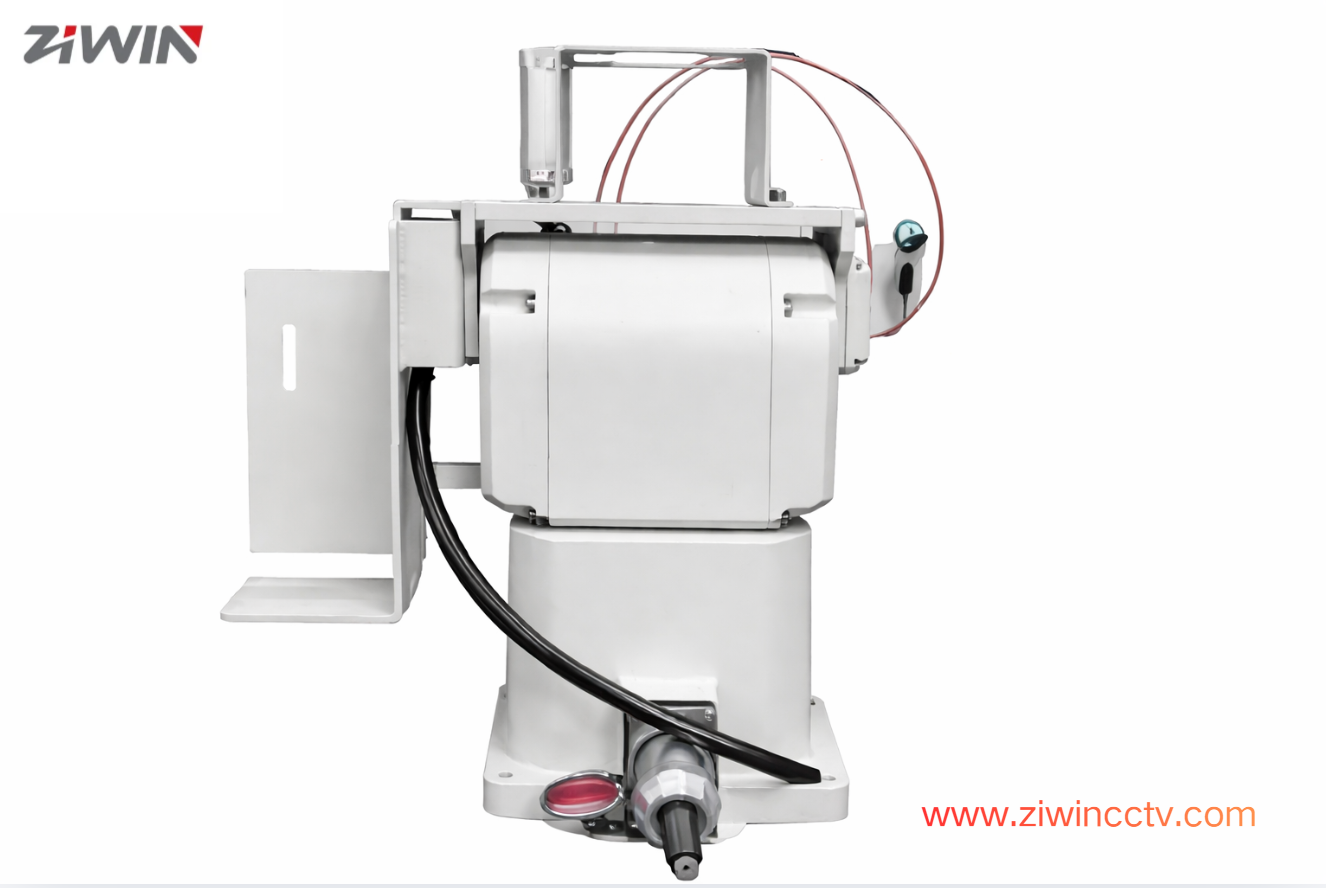
Difficulties of Multi-Channel Integration in Constrained Regions
The pan tilt is inherently sensitive to size and weight, while dual channel RF slip rings are typically required to land among a constellation of additional channels power channels, control signal (e.g., RS-485 or Ethernet) and sensor/feedback signals. Enabling the integration of such dual RF channels into multiple low-frequency signals, along with adequate electromagnetic isolation and structurally compatible heat dissipation in a confined structural space is a complicated systems engineering problem. In such environment its internal structure design, channel layout and shielding (protection) measures of the slip ring play a crucial role on global performance and reliability of the dual-channel RF PTZ.
The Coupling Issue of Machining Precision and RF Performance
The mechanical and RF subsystems are closely related in a dual-axis RF pan tilt system. The slip ring, which acts as a “rotating interface,” can introduce into the RF signal path even slight centering and concentricity errors in addition to axial and radial runout, vibration during rotation, and wear due to long-term use. The dual channel RF systems are more susceptible to coupling of this sort than a single-channel system, inasmuch as instability occurring in either the channels will effect overall performance and thus obtaining relative constancy between the two signals is not easily managed. This dependence highlights the importance of the slip ring in dual-channel RF gimbals where mechanical accuracy and RF performance are closely coupled.
Challenges of Long-Term Reliability and Environmental Robustness
Dual-channel RF pan tilt systems are widely used in vehicle, ship and outdoor fixed-station applications, and may experience high wind loads or strong vibration. To achieve such applications, the slip ring should provide stable RF performances during long-time rotation in complex environment. In dual-channel RF systems which fail in one channel the system functions will be lost while, on the other hand, performance drift is typically more difficult to detect and trouble than outright failure. Therefore, to develop a dual-channel RF pan tilt system, how to design the working life, material and environmental adaptability of its slip ring is very important.
2 Slip Ring Design at System Level In preparing the design of a complete slip ring assembly, what is a system level design?
From the systems engineering perspective, the total performance of a dual-channel RF pan tilt system is formulated as:
Performance of the Dual-Channel RF pan tilt System=RF Front-End Performance X Antenna Characteristics X pan tilt system Pointing Accuracy X Multi-Channel RF Consistency and Stability + Slip Ring.
Under such condition, the slip ring is not only a “connector” but also a key or even one of the core devices which influence on the system's overall capabilities and performance limits.
Conclusion
For dual-channel RF pan tilt system, the complexity and correlation of slip ring design is higher than single channel RF use. The channel isolation, impedance stability, insertion loss uniformity, mechanical / RF coupling and long term reliability are the main issues to determine the difficulties of dual-channel RF slip ring design. Such challenges at the system level are not fully understood and are crucial in realizing the full potential of dual-channel RF pan tilt systems in high-frequency, high-reliability applications.
 +86-15022658927
  sales@ziwincctv.com
  English
 français
 Deutsch
 Español
 italiano
 русский
 português
 العربية
 tiếng việt
 ไทย
ไทย Türkçe
 Pilipino
 עברי
עברי Afrikaans
 Polska