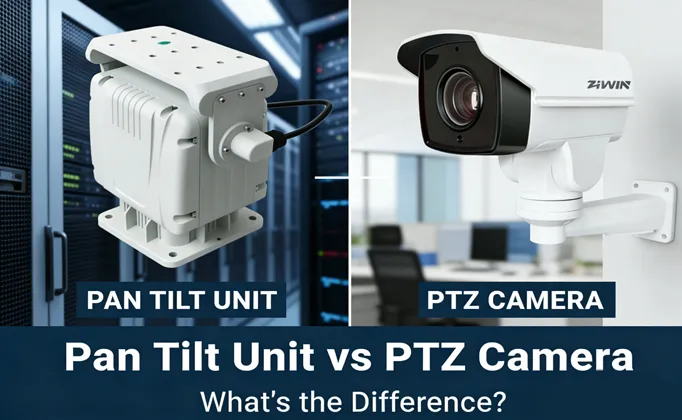
A pan tilt unit is a mechanical positioning device that moves external equipment—such as cameras, sensors, radar, or thermal modules—by controlling horizontal (pan) and vertical (tilt) motion. A PTZ camera, in contrast, integrates the camera, lens, and movement mechanism into a single device.
In professional surveillance systems, the choice between a pan tilt positioner and a PTZ camera depends on system architecture, payload requirements, and monitoring distance. Pan & tilt positioners are commonly used in long-range security systems where heavy payloads, thermal sensors, or specialized optical cameras are required. PTZ cameras are typically used in standard surveillance scenarios where a compact all-in-one device is sufficient.
Understanding the difference between these two technologies is essential for designing reliable long-distance surveillance systems.
What Is a Pan Tilt Unit?
A pan tilt unit is an electromechanical platform designed to precisely rotate mounted equipment along two axes. It acts as a positioning system that allows operators or automated systems to control the viewing direction of cameras or sensors.
Unlike PTZ cameras, a pan and tilt positioner does not contain an integrated imaging module. Instead, it supports external payloads such as:
Because the imaging system is separate, pan tilt positioners offer greater flexibility for complex surveillance systems.
Typical capabilities of industrial pan tilt units include:
High payload capacity
Precision positioning control
Continuous rotation capability
Integration with radar or tracking systems
Support for heavy optical systems
This modular architecture is commonly used in border security, military surveillance, and critical infrastructure monitoring.
What Is a PTZ Camera?
A PTZ camera combines the camera sensor, zoom lens, and pan-tilt mechanism within a single integrated housing.
The PTZ design is compact and easy to deploy, making it widely used in commercial surveillance systems such as:
Building security
Parking lot monitoring
Traffic observation
Retail and public safety
PTZ cameras allow operators to remotely control viewing direction and zoom level, but the internal mechanical structure limits payload capacity and customization.
In applications requiring advanced sensors or specialized optical systems, a pan tilt positioner often provides more flexibility than a traditional PTZ camera.
Key Differences Between Pan Tilt Units and PTZ Cameras
System Architecture
The most fundamental difference lies in system design.
A pan tilt unit acts as a positioning platform for external devices, while a PTZ camera integrates the camera and motion system into one device.
With pan & tilt positioners, system integrators can choose specific sensors and cameras to mount on the platform. This allows greater customization for specialized monitoring tasks.
PTZ cameras, by contrast, are preconfigured devices with fixed optical and sensor specifications.
Payload Capacity
Industrial pan tilt positioners are engineered to support heavier equipment than PTZ cameras.
Typical payload capacities may include:
Because the pan and tilt positioner is designed as a standalone motion platform, it can support significantly larger and heavier surveillance systems.
PTZ cameras are limited by their integrated housing and internal motors.
Monitoring Distance
In long-range surveillance systems, pan tilt units often provide superior performance.
A pan tilt positioner can support professional long-focal-length lenses and large optical cameras designed for extreme-distance monitoring. These configurations are commonly used for:
PTZ cameras can still achieve strong zoom performance, but their integrated design limits the maximum optical system size.
System Flexibility
A major advantage of pan & tilt positioners is modular system flexibility.
Because the camera is not built into the device, operators can upgrade or replace sensors without changing the entire motion platform. This makes pan tilt units ideal for long-term infrastructure deployments.
For example, a system might combine:
Thermal camera for detection
Optical zoom camera for identification
Laser rangefinder for distance measurement
All mounted on a single pan and tilt positioner.
PTZ cameras do not offer this level of customization.
Maintenance and Upgrade Capability
Maintenance considerations also differ between the two technologies.
With pan tilt positioners, cameras and sensors can often be serviced independently of the motion system. This modular design simplifies repairs and system upgrades.
PTZ cameras typically require replacement of the entire device if critical components fail.
For large security infrastructures, the serviceability of pan tilt units is a major advantage.
Are Pan Tilt Units Better Than PTZ Cameras?
A pan tilt unit is generally better suited for long-range surveillance systems and multi-sensor monitoring platforms.
However, PTZ cameras remain highly effective for general-purpose surveillance where:
Installation simplicity is important
Payload requirements are small
Monitoring distances are moderate
Both technologies play important roles in modern security architectures.
What Is a Pan Tilt Positioner Used For?
A pan tilt positioner is commonly used in advanced surveillance systems that require precise directional control of cameras or sensors.
Typical applications include:
Border and coastal surveillance
Military monitoring systems
Critical infrastructure protection
Long-distance perimeter security
Wildlife monitoring systems
Because pan & tilt positioners support heavy payloads and specialized sensors, they are frequently used in high-performance surveillance environments.
Can a Pan Tilt Unit Be Used With PTZ Cameras?
Yes. In some advanced systems, a PTZ camera can be mounted on a pan tilt unit to extend movement range or improve tracking capability.
However, this configuration is less common because PTZ cameras already include their own pan-tilt mechanism.
More commonly, pan and tilt positioners are paired with fixed optical cameras or multi-sensor payload systems.
How Do Pan & Tilt Positioners Work?
Pan tilt units use motorized drives to rotate mounted equipment along horizontal and vertical axes.
The system typically includes:
Servo or stepper motors
Precision gear mechanisms
Position feedback sensors
Control interfaces for remote operation
Operators or automated tracking systems can send commands to the pan tilt positioner, allowing the mounted camera or sensor to move toward a specific target.
This precision control is critical in long-distance surveillance systems.
When Should You Choose a Pan Tilt Unit?
A pan tilt unit is the preferred solution when surveillance systems require:
Heavy sensor payloads
Long-distance optical cameras
Multi-sensor integration
High-precision positioning
Advanced tracking capability
Large-scale security projects often rely on pan & tilt positioners to support complex monitoring systems.
Conclusion
Both pan tilt units and PTZ cameras provide directional control for surveillance systems, but they serve different roles within modern security architectures.
A pan tilt positioner acts as a modular positioning platform capable of supporting heavy sensors, long-distance cameras, and multi-sensor payloads. PTZ cameras offer a compact, integrated solution that simplifies installation and operation.
For high-performance monitoring environments—such as border security, coastal surveillance, and industrial perimeter protection—pan tilt units provide the flexibility and scalability required for advanced surveillance systems.
Frequently Asked Questions
What is a pan tilt unit?
A pan tilt unit is a motorized positioning device that allows cameras or sensors to rotate horizontally and vertically for precise directional control.
What is the difference between a pan tilt positioner and a PTZ camera?
A pan tilt positioner is a motion platform designed to carry external cameras or sensors, while a PTZ camera integrates the camera, lens, and movement mechanism into a single device.
What are pan & tilt positioners used for?
Pan & tilt positioners are commonly used in long-range surveillance systems, military monitoring platforms, and critical infrastructure protection where heavy sensors or specialized cameras must be precisely controlled.
Can a pan and tilt positioner support thermal cameras?
Yes. A pan and tilt positioner can support a wide range of payloads, including thermal imaging cameras, optical zoom cameras, radar sensors, and other monitoring equipment.
Are pan tilt units suitable for outdoor surveillance?
Industrial pan tilt units are typically designed with weatherproof housings and corrosion-resistant materials, making them suitable for outdoor surveillance environments such as borders, ports, and industrial sites.
 +86-15022658927
  sales@ziwincctv.com
  English
 français
 Deutsch
 Español
 italiano
 русский
 português
 العربية
 tiếng việt
 ไทย
ไทย Türkçe
 Pilipino
 עברי
עברי Afrikaans
 Polska