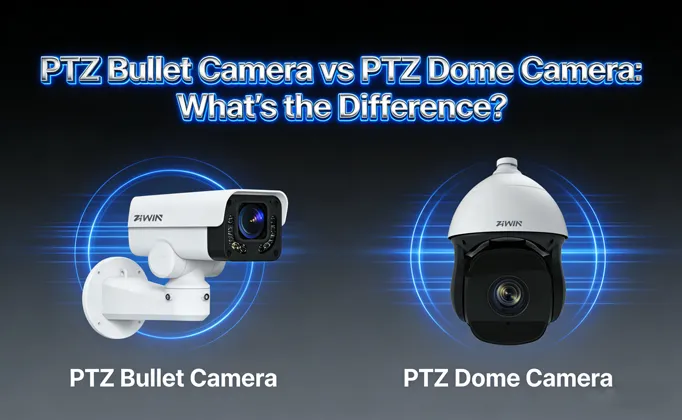
A PTZ bullet camera is typically better suited for long-distance outdoor monitoring and perimeter security, while a PTZ dome camera is designed for discreet surveillance and flexible indoor or urban monitoring environments. The key difference lies in structural design, installation scenarios, and performance in long-range observation.
Both camera types include PTZ (Pan-Tilt-Zoom) functionality, allowing operators to remotely control viewing direction and zoom levels. However, their housing structure and engineering design significantly influence their real-world performance. In professional surveillance projects—such as industrial facilities, border protection, and smart city monitoring—choosing between a PTZ bullet camera and a PTZ dome camera can directly affect coverage efficiency, maintenance requirements, and overall system reliability.
Structural Design Differences
The most visible difference between the two camera types is the physical design.
A PTZ bullet camera typically features an elongated housing that resembles traditional bullet security cameras. This structure allows manufacturers to integrate larger optical zoom lenses, longer focal lengths, and additional thermal or sensor modules. Because of this, PTZ bullet models are often used for long-distance surveillance and large-area monitoring.
PTZ dome cameras, on the other hand, are built within a dome-shaped enclosure. The camera mechanism is protected inside the dome cover, which conceals the direction of the lens and improves vandal resistance.
Key structural differences include:
| Feature | PTZ Bullet Camera | PTZ Dome Camera |
Housing Shape | Long bullet-style body | Dome enclosure |
Lens Capacity | Supports larger zoom lenses | Limited lens size |
Visibility | Clearly visible direction | Direction concealed |
Installation Style | Wall or pole mounting | Ceiling or bracket mounting |
Typical Use | Outdoor long-range monitoring | Indoor or urban surveillance |
The larger housing of a PTZ bullet camera allows for enhanced optical systems and additional hardware components.
Long-Distance Monitoring Capability
One of the biggest advantages of a PTZ bullet camera is its ability to support long-range optical zoom.
Because the bullet structure can accommodate larger lenses, these cameras often deliver:
Higher optical zoom ratios
Longer focal length lenses
Greater identification distance
Improved image clarity at long range
This makes the PTZ bullet camera ideal for applications such as:
PTZ dome cameras can still offer powerful zoom capabilities, but their compact design limits the maximum optical system size.
Installation and Mounting Flexibility
Installation requirements differ significantly between these two camera types.
A PTZ bullet camera is commonly mounted on:
The elongated housing allows the camera to project outward, providing unobstructed viewing angles for long-distance monitoring.
PTZ speed dome cameras are frequently installed on ceilings or building corners. Their compact form makes them suitable for locations where aesthetics and space limitations are important.
For large outdoor monitoring zones, the PTZ bullet camera often provides better directional coverage.
Visibility and Deterrence
Another important difference is how visible the camera is to people in the monitored area.
A PTZ bullet camera is highly visible and clearly indicates its viewing direction. This visibility can act as a psychological deterrent against potential intruders or unauthorized activities.
PTZ dome cameras conceal the direction of the lens behind a tinted dome. This makes it difficult for individuals to determine where the camera is pointing, which can improve surveillance effectiveness in retail stores, offices, and public spaces.
The choice between deterrence and discreet monitoring often determines whether a PTZ bullet camera or dome camera is more appropriate.
Environmental Protection and Durability
Outdoor surveillance systems must withstand harsh environmental conditions such as rain, wind, dust, and extreme temperatures.
Because of their industrial design, PTZ bullet cameras are often engineered with heavy-duty housings and advanced weatherproof protection. Many models include:
High IP-rated waterproofing
Integrated heaters or cooling systems
Long-distance infrared illumination
Anti-corrosion materials
These features make the PTZ bullet camera particularly suitable for demanding outdoor environments such as ports, deserts, and coastal areas.
PTZ dome cameras are also weather-resistant but are more commonly used in semi-outdoor or controlled environments.
Maintenance and Accessibility
Maintenance requirements can differ depending on the design.
The exposed housing of a PTZ bullet camera typically allows easier access to internal components for servicing or upgrades. Technicians can often replace modules or perform maintenance without removing complex protective enclosures.
PTZ dome cameras require removal of the dome cover for maintenance, which may involve additional sealing and recalibration procedures.
For large industrial installations where regular servicing may be required, the PTZ bullet camera design can simplify maintenance operations.
Are PTZ Bullet Cameras Better for Outdoor Security?
In many perimeter security applications, a PTZ bullet camera is preferred due to its longer optical zoom capability, stronger housing, and ability to integrate additional sensors.
These cameras are widely used for monitoring large open areas where distant objects must be clearly identified. Their structural design supports high-performance imaging systems that perform reliably in harsh environments.
However, dome cameras remain highly effective for urban surveillance, building monitoring, and areas where a discreet appearance is required.
What Is the Main Advantage of a PTZ Dome Camera?
The main advantage of PTZ dome cameras lies in their compact design and discreet monitoring capability.
Because the camera direction is hidden inside the dome, individuals in the monitored area cannot easily determine where the camera is pointing. This makes PTZ dome cameras effective for:
Retail stores
Office buildings
Transportation hubs
Public safety monitoring
In these environments, the goal is continuous observation without drawing excessive attention to the camera.
Can a PTZ Bullet Camera Replace a PTZ Dome Camera?
A PTZ bullet camera can replace a dome camera in many outdoor monitoring scenarios, particularly when long-distance surveillance is required.
However, in indoor spaces or locations where aesthetics and compact installation are priorities, dome cameras remain a better fit.
Professional surveillance systems often deploy both types simultaneously—using PTZ bullet cameras for perimeter monitoring and PTZ dome cameras for interior or close-range observation.
How to Choose Between a PTZ Bullet Camera and a Dome Camera
When selecting the right PTZ camera type for a project, several factors should be evaluated.
Important considerations include:
Monitoring distance requirements
Installation environment
Weather exposure
Deterrence vs discreet monitoring needs
Maintenance accessibility
For large industrial or infrastructure projects, the PTZ bullet camera is often the preferred solution due to its optical performance and durability.
Conclusion
Both PTZ bullet cameras and PTZ dome cameras provide flexible surveillance through pan, tilt, and zoom functionality, but their design differences make them suitable for different applications.
A PTZ bullet camera excels in long-distance outdoor monitoring, offering superior optical zoom capability, rugged housing, and strong deterrence visibility. PTZ dome cameras are better suited for discreet surveillance in indoor or urban environments where space and aesthetics are important considerations.
In modern surveillance architectures, combining both technologies often provides the most comprehensive security coverage—leveraging the long-range capability of PTZ bullet cameras alongside the flexibility and discretion of dome cameras.
Frequently Asked Questions
What is a PTZ bullet camera used for?
A PTZ bullet camera is commonly used for long-range surveillance in outdoor environments such as industrial facilities, transportation infrastructure, and perimeter security zones.
Are PTZ bullet cameras good for outdoor security?
Yes. The PTZ bullet camera design is well suited for outdoor security due to its weather-resistant housing, powerful zoom lenses, and ability to monitor large areas.
What is the difference between a bullet camera and a dome camera?
Bullet cameras have an elongated housing that makes the camera direction visible, while dome cameras are enclosed in a dome cover that hides the lens direction.
Which is better: PTZ bullet camera or PTZ dome camera?
The better choice depends on the application. A PTZ bullet camera is ideal for long-range monitoring and perimeter security, while PTZ dome cameras are better suited for discreet surveillance in indoor or urban environments.
Can PTZ cameras track moving objects?
Many modern PTZ cameras support intelligent tracking features that allow them to automatically follow moving targets within the monitored area.
 +86-15022658927
  sales@ziwincctv.com
  English
 français
 Deutsch
 Español
 italiano
 русский
 português
 العربية
 tiếng việt
 ไทย
ไทย Türkçe
 Pilipino
 עברי
עברי Afrikaans
 Polska