Introduction
For long range security projects, the question clients often pose is: Which kind of long-range PTZ camera is best for me if I need to track targets beyond 2 km, 3 km, 4 km and possibly even up to 6km?
Now at first sight, this seems like an easy distance question. But choosing the right long-range PTZ camera is much more than just how many kilometers it has a field of view.
Both zoom capability and many other conditions have an effect on the performance of surveillance cameras, they are target type, operation requirements (day-time/night-time), lens focal length, image sensor quality, illumination method we may need to mention PTZ stability installation condition and also project-specific needs.
The specification sheet lists a “maximum distance,” but you cannot accurately compare that to the maximum distance of wired options. A camera at all optimistically works in daylight but badly at night, or it may identify a target without sufficient detail to tell whether its a person, vehicle, boat. Furthermore, zoomed in images can occasionally result in inconsistent and impractical applications in real life.
And for these reasons, the choice of a long-range PTZ camera should never be based on a single parameter but always viewed as an integrated system solution.
Before Choosing a Long Range PTZ Camera, First Define What You Need to See
Many users begin by asking:
“What camera do I need for 4 km surveillance?”
But the more important question is:
What exactly do you need to see at 4 km, and what level of detail do you require?
In long-range surveillance, requirements are usually divided into three levels:
1. Detection
At this level, you are just figuring out whether a target is present (e.g. person, car, boat or source of fire).
2. Recognition
At this stage is classified only in terms of the broad category of what it is—for example, a person or vehicle; boat vs other.
3. Identification
This means images must be more detailed in image quality, so that certain characteristics or behaviours can be seen (or markings or labels on the object in some cases).
These three levels require very different system capabilities.
For example, in a 6 km surveillance project:
· If you only need to detect vehicle movement in the distance, the system requirement is relatively lower.
· If you want to recognize people or vehicles at 6 km, the difficulty increases significantly.
· If you also need effective surveillance at night, then thermal imaging or laser illumination is usually required.
So, distance alone is not the real starting point. The actual target and the expected imaging result are what matter most.
Daytime and Nighttime Surveillance Distances Are Usually Different
Although this is a top important consideration in the long-range PTZ camera selection, it is commonly forgotten. Many customers often state:
"I need 3 km of surveillance camera."
But in practice, this needs to be clarified further:
Do you mean 3 km during the day, or 3 km at night? Is it for daytime observation only, or for 24/7 surveillance?
The reason is simple: the same camera usually performs very differently in daytime and nighttime conditions.
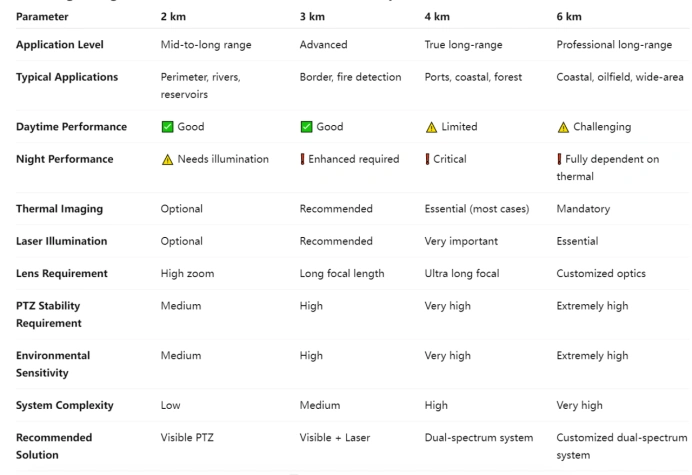
Long-Range PTZ Camera Selection Guide: 2km, 3km, 4km & 6km
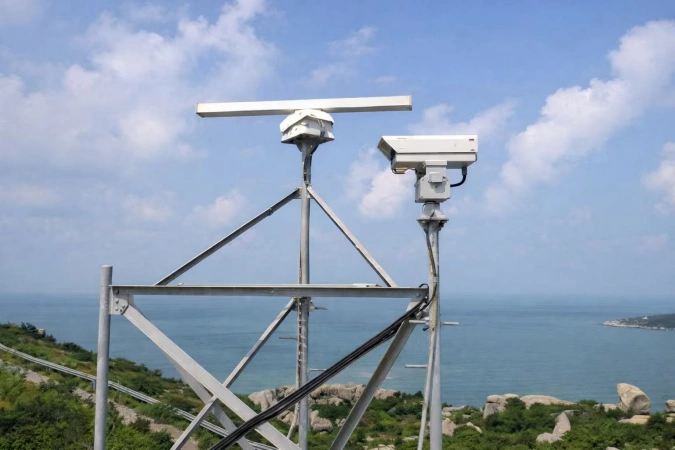
Key Questions to Confirm Before Choosing a Long Range PTZ Camera
To avoid choosing the wrong direction, it is important to clarify the following points before discussing a solution with a supplier:
1. How far away do you have to be to surveil?
Is the target here — at 2 km, 3 km, maybe 4 km or all the way out to 6 km?
2. What Kind of Target Is It?
Does it focus on a person, vehicle, boat, fire source or stationary facility?
3. Is day-night surveillance requirement same?
Whereas daytime project many focus on observation detail, nighttime often emphasize detection or early warning.
4. What kind of surveillance output do you expect?
Is it even enough that the target is simply detected? Do we need to either recognize or fully identify it?
5. Which environmental conditions camera is going to face?
Do strong winds, coastal corrosion, fog, rain or snow, heat haze, vibrations impact upon performance?
Conclusion: Different Distances Require Different Long Range PTZ Camera Solutions
Single Solution Unforgiving for surveillance projects over 2 km 3 km 4 and even up to 6 km, there are no myriad of configurations where one fit all. Choosing the right long-distance PTZ camera relies on several aspects including:
· Distance
· Target size
· Separate needs for night and day use
· Environmental conditions
· Desired level of surveillance
· Project budget
· Stability of the platform and how well is the system working
For the projects requiring only long-distance detection during daylight hours, a visible-light PTZ camera with a long focal-length lens will do. But solutions that include laser illumination or thermal imaging almost invariably outperform it when used for continuous 24/7 surveillance.
A commercially available dual-spectrum or bespoke long-range surveillance system is usually the most suitable option for applications beyond 4 km, especially at a range such as 6km.
In the end, camera selection should not be based only on a datasheet. It should begin with the real target, the actual environment, and the true application needs of the project.
 +86-15022658927
  sales@ziwincctv.com
  English
 français
 Deutsch
 Español
 italiano
 русский
 português
 العربية
 tiếng việt
 ไทย
ไทย Türkçe
 Pilipino
 עברי
עברי Afrikaans
 Polska