Introduction: Anti-Drone Systems Are More Than Sensors
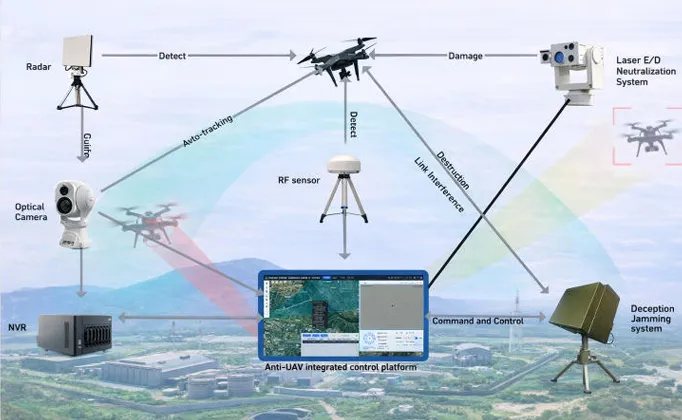
With drones and UAVs shrinking in size, cost and ease of use, so too have anti-drone solutions moved from the periphery to a key aspect of low-altitude security mechanisms. Airports, vital installations, borders and urban areas all have greater reliance on the use of systems that enable detection, tracking and mitigation of rogue drones.
Industry conversations often revolve around radar range, camera resolution and AI algorithms. Yet, in reality, system performance often depends upon a less-obvious—but no less important—aspect of any deployment; the pan-tilt positioner.
Obviously, in any anti-drone system they are not tag-along equipment as well, sometimes it all comes down to them.
Pan-Tilt Positioners and Anti-Drone Architectures
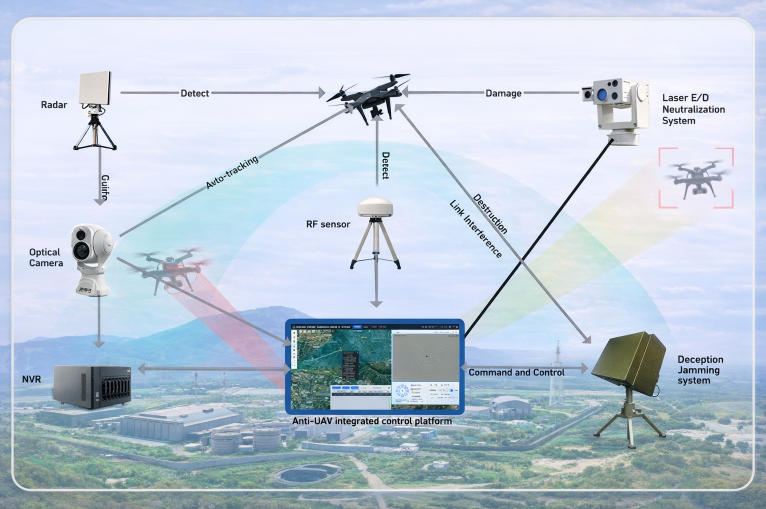
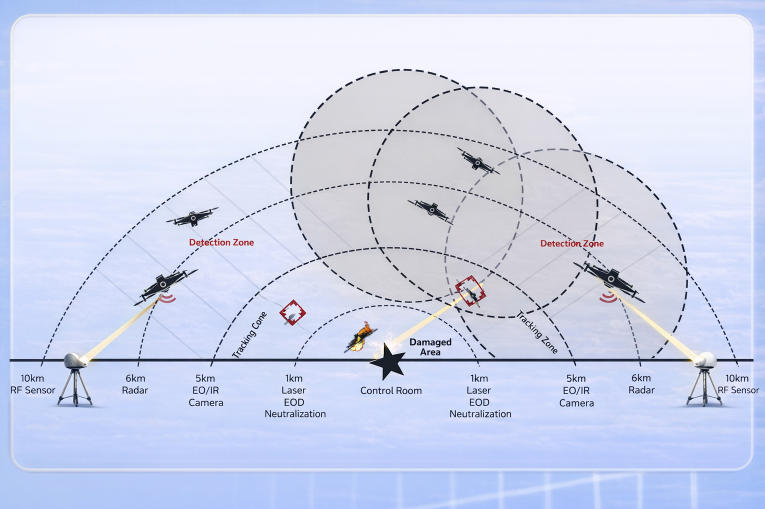
A common anti-drone system consists of three highly integrated layers:
Detection
Surveillance radar or RF sensors (passive) detect potential targets and objects in the airspace.
Identification and Tracking
EO/IR sensor offers 'real' visual confirmation and sustained monitoring.
Mitigation
The target is engaged with directional RF systems, jammers or other effectors.
So throughout these levels, pan-tilt positioners have one simple but essential role: they bring sensor and effector into physical alignment with the target in real space. Mistarget and even the best sensors become unserviceable.
Precision Pointing: Where Mechanical Accuracy Becomes Mission-Critical
Performance of Radar Depends on Pointing Accuracy
Radar antennae in may anti-drone systems are installed on pan-tilt positioners for sector scanning or target tracking. Geometrical pointing errors are mapped directly into radar performance:
Reduced detection probability
Unstable tracking
Increased false alarms
For pencil beam or tracking radar, mechanical precision is a continuity of the performance of the radar.
EO/IR Tracking Requires Stable Line-of-Sight Control
EO/IR sensors require consistent, repeatable control over line of sight to track small and fast moving UAVs. When distances and targets become far ranging, even off by a tenth of a degree can cause losing your target. Classic problems like vibration, sloppiness or poor repeat tend to be mistaken for software bugs - when the issue lies in mechanical stability.
Why Basic Pan-Tilts Are Not Enough
Not all pan-tilts are appropriate for anti-drone systems.” A "pan tilt unit" (PTU) is not the same as a standard pan-tilt mechanism:
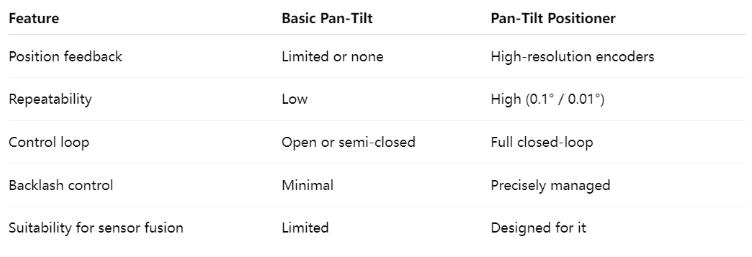
Anti-drone systems rely on precise angular data for sensor fusion, radar to EO/IR handoff and automated tracking. Clearly, such requirements can only be met with positioners that have highly accurate feedback and repeatability.
Continuous Tracking Requires Continuous Rotation
Drones do not approach from predictable directions, and anti-drone systems are typically required to operate:
24/7
In all weather conditions
Without manual intervention
Learn more The narrow rotation ranges cause blind spots, re-homing, and interrupt the tracking. Consistent yet smooth tracking is facilitated as a result of the continuous azimuth rotation and is especially important during high speed target acquisition.
To allow uninterrupted rotation, pan tilt positioner must reliably transmit:
Power
Control and data signals
RF signals
This is achieved through integrated slip rings and RF rotary joints—critical components for long-term system reliability.
Multi-Sensor Payloads Demand Structural Stability
photo While this is a good sensor, most new anti-drone systems use more than one kind of sensor. A typical configuration may include:
Radar antennas
EO cameras
Thermal imagers
RF antennas
There is a high demand on the pan-tilt positioner by mounting of multi-sensors on the same platform which require large payload capacity, good structural stiffness and accurate center-of-gravity (CoG) allocation. Mechanical deflection or motion impairs pointing accuracy and hence, overall system efficiency.
Long-Term Reliability in Real-World Deployments
Anti-drone systems aren’t one-off missions but permanent installations designed to function over years. Accuracy in PT positioner design is paramount, particularly when the:
Wind loads
Temperature variations
Continuous motion
Environmental exposure
As the result, "mechanical design, bearing quality, encoder resolution and control-loop stability are just as important as sensor details."
The key requirements for the pan tilt positioner in anti-drone system
When choosing a pan-tilt positioner for anti-drone usage, integrators must treat it as any other system component and evaluate it based on:
Pointing accuracy and repeatability
Minimal backlash and vibration
Continuous rotation capability
Payload for multi-sensor system configurations
Consistent transfer of power, data and RF signals
Outdoor protection (generally IP65/IP66 or high)
Considering the pan-tilt positioner as a basic mounting device is a big and expensive mistake.
Conclusion: Precision Mechanics Enable Effective Anti-Drone Systems
Anti-drone systems are often defined by their sensors and software, but their real-world performance depends on how accurately those sensors are physically deployed and controlled.
Pan-tilt positioners provide the mechanical precision, stability, and continuity that make detection, tracking, and mitigation possible.
In anti-drone systems, precision mechanics are not a supporting detail.
They are the foundation on which the entire system operates.
 +86-15022658927
  sales@ziwincctv.com
  English
 français
 Deutsch
 Español
 italiano
 русский
 português
 العربية
 tiếng việt
 ไทย
ไทย Türkçe
 Pilipino
 עברי
עברי Afrikaans
 Polska