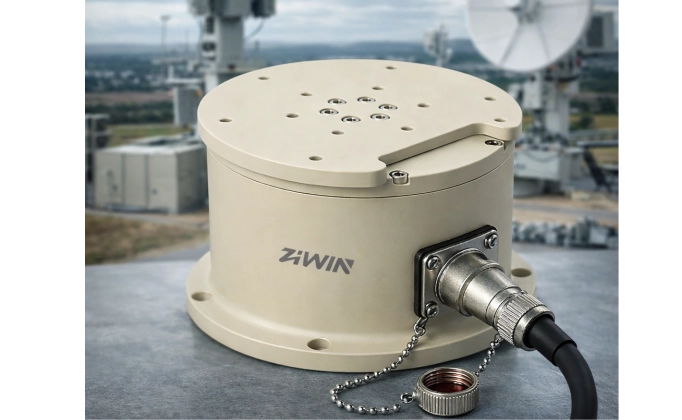
Antennas and radar systems are inherently directional. Their performance depends not only on sensor quality, but also on how accurately and reliably they are oriented in space.
When designing such systems, one key decision is selecting the right positioning platform. While pan tilt positioners are widely known, many antenna and radar applications do not require full two-axis motion. In these cases, a horizontal rotary positioner, also known as an azimuth positioner, often provides a more efficient and robust solution.
This article, provided by Ziwin, explains how to choose the right positioner for antenna and radar systems, and when a single-axis horizontal solution is the better choice.
Why Directional Control Matters in Antenna and Radar Systems
Both antennas and radars rely on precise orientation to function correctly.
* Antennas must be aligned to establish and maintain directional communication links.
* Radars must scan defined areas to detect, track, and monitor targets.
In most systems, horizontal direction (azimuth) is the primary variable. Vertical alignment is often fixed, mechanically preset, or handled by the sensor design itself. As a result, controlling azimuth accurately is usually more important than providing full pan-tilt flexibility.
What Is an Antenna Positioner?
An antenna positioner is a mechanical platform used to orient an antenna toward a desired direction.
In many communication and detection systems, antenna positioners are used to:
* Point antennas toward specific locations
* Scan across defined sectors
* Search for and lock onto signals
When antenna motion is limited to horizontal rotation, a horizontal rotary positioner serves as a compact and reliable antenna positioner, offering precise azimuth control with minimal system complexity.
Using a Horizontal Rotary Positioner for Antennas
Horizontal rotary positioners are widely used in antenna applications where azimuth control is the primary requirement.
Typical antenna use cases include:
* Directional communication antennas
* Radar antennas
* RF monitoring and spectrum analysis antennas
In these systems, a horizontal rotary platform enables:
* Accurate azimuth alignment
* Repeatable scanning patterns
* Stable long-term operation under load
By eliminating unnecessary vertical motion, the system becomes easier to integrate, control, and maintain.
What Is a Radar Positioner?
A radar positioner is used to orient radar sensors for scanning and tracking purposes. Depending on the application, radar systems may require either multi-axis or single-axis motion.
Many radar systems rely on horizontal scanning to monitor surrounding areas. For these applications, a horizontal rotary positioner provides an efficient way to rotate the radar sensor across a full 360° range or within predefined sectors.
Using a Horizontal Rotary Positioner for Radar Systems
In radar-based systems, horizontal rotary positioners are commonly used for:
* Perimeter surveillance
* Coastal and maritime monitoring
* Anti-drone detection
* Critical infrastructure protection
Mounted on a horizontal rotary platform, radar systems can:
* Perfom continuous azimuth scanning
* Track targets across wide areas
* Maintain consistent orientation and repeatability
Because radar modules are often relatively heavy, single-axis platforms also offer advantages in terms of load capacity and mechanical stability.
When Is a Pan Tilt Positioner Necessary for Antennas or Radars?
While horizontal rotary positioners are sufficient for many applications, there are cases where a pan tilt positioner is required.
Pan tilt positioners are typically necessary when:
* Targets move significantly in elevation as well as azimuth
* Vertical scanning is essential to system performance
* The system must track airborne or elevated objects in three-dimensional space
Examples include advanced tracking systems deployed in mountainous terrain or applications requiring continuous vertical angle adjustment.
Key Factors to Consider When Selecting a Positioner
When choosing a positioner for antenna or radar systems, it is important to consider the following factors:
* Motion requirements: azimuth only or azimuth + elevation
* Payload weight: including antennas, radars, brackets, and cables
* Positioning accuracy: required pointing precision and repeatability
* System integration: control interfaces and communication protocols
* Environmental conditions: wind, temperature, and outdoor exposure
Evaluating these factors early in the design process helps ensure that the selected positioner matches real operational needs.
Conclusion
Selecting the right positioner is a critical step in designing reliable antenna and radar systems.
For applications where azimuth control is the primary requirement, a horizontal rotary positioner offers a compact, stable, and efficient solution. It simplifies system design while delivering the precision needed for directional communication, scanning, and detection.
Pan tilt positioners remain essential for applications requiring full three-dimensional motion, but in many antenna and radar systems, single-axis horizontal platforms provide the optimal balance between performance and complexity.
 +86-15022658927
  sales@ziwincctv.com
  English
 français
 Deutsch
 Español
 italiano
 русский
 português
 العربية
 tiếng việt
 ไทย
ไทย Türkçe
 Pilipino
 עברי
עברי Afrikaans
 Polska