A Practical Guide from System Requirements to Engineering Implementation
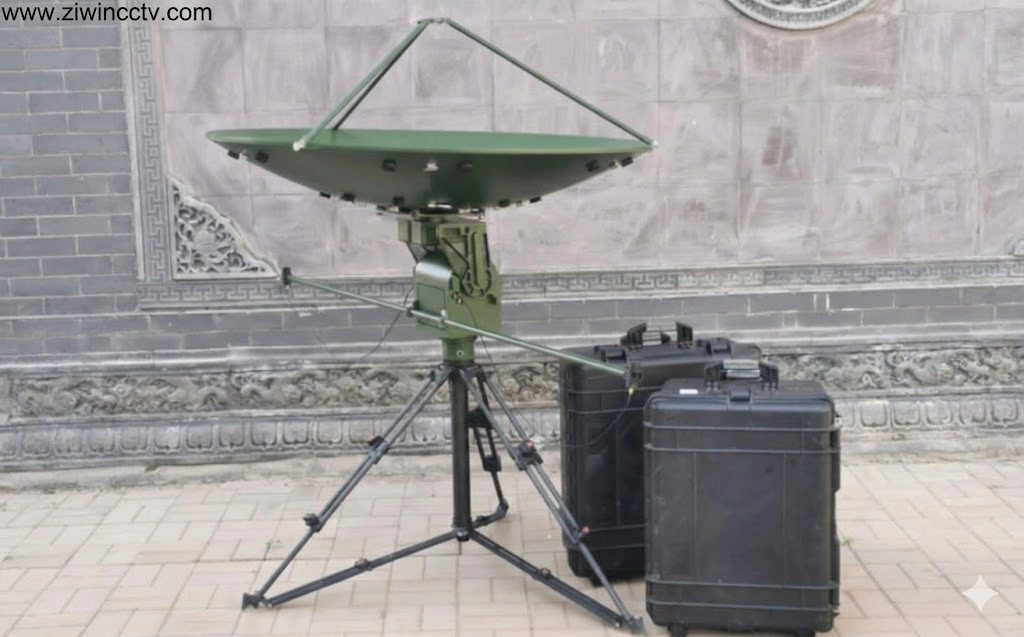
For radar, communication and counter-UAS systems, antennas are frequently attached to PAN-tilt-units (PTUs) so as to provide complete azimuth coverage and accurate pointing. An important but often ignored issue in these applications is the routing of RF signals between stationary side and rotating platform. The requirement of dual RF feedthroughs in conjunction with the challenges available in selecting an appropriate pan-tilt unit to accommodate them has a major impact on system stability and signal integrity as well as long term reliability.
This paper is a systematic and engineering-oriented instruction for choosing suitable pan-tilt unit with double RF feedthroughs in antenna system, detailing the aspects of RF performance, mechanical design, and the practical integration issues.
First Question: Does Your Antenna System Really Need Dual RF Channels?
In comparing any pan-tilt specifications, it is important to understand the system architecture implicit to them.In many cases, a pair of RF feedthroughs are not an option but rather a necessity. These scenarios include:
a.Separate transmit (TX) and receive (RX) signal paths
b.Main antenna plus backup antenna for redundancy
c.Multi-band operation (e.g., low-frequency communications + microwave sensing)
d.Simultaneous monitoring and active transmission or jamming
e.Online testing, calibration, or maintenance without interrupting operation
In this context, going for a pan-tilt mechanics that inherently allows for dual RF feedthrough is the most robust engineering answer.
RF Performance Comes First — Not Just Rotation Capability
An often-made error regarding pan-tilt selection is placing too high weight on rotation angle and speed, rather than RF performance. To characterize dual-RF pan-tilt units, the following RF parameters need to be specified:
Typical ratings include:
DC–3 GHz
DC–6 GHz
DC-8GHz
DC-18GHz
Additional frequency capability requires significantly more demanding mechanical tolerances, better materials, and more complex designs of the RF rotary joint. A good rule of thumb is to select a range that meets system needs but does not overshoot by much.
Insertion Loss and Stability During Rotation
Positively, low insertion loss not only improves the detection distance but also benefits communication quality. But is more important the stability of this lost with constant rotation. Some of the low-end designs may meet RF requirements on static tests, but readings can vary heavily under rotation which is not acceptable for real use cases.
Channel Isolation (Critical for Dual RF)
Real dual RF requires a high-isolation between channels and low coupling of high-power transmit paths into the sensitive receive path. It is this parameter that separates true dual-RF designs from those with only “two cables sharing a structure.”
Continuous 360° Rotation Must Be Natively Supported
If the antenna system necessitates:
a.Unlimited 360° continuous rotation
b.24/7 long-term operation
In that case, it would make sense to throw out those solutions which rely on outer cable loops or wiring with limited rotation right away. An appropriate dual-RF pan-tilt head should contain:
a.RF rotary joints mounted in the PTU
b.Two free RF channels for any rotation
c.Physical isolation of RF, power and control signals
This is important to distinguish between engineering-grade systems and temporary, laboratory solutions.
Mechanical Precision Directly Affects RF Performance
It is wrong to treat RF and mechanical design as two separate disciplines. The mechanical construction of dual-RF type pan-tilt unit determines performances limited by RF.
The important mechanical factors to see are:
a. Coaxiality and radial run-out of the > main-shaft
b. Micro-vibration during rotation
c. Length, mass, and CG height of the antennas
d. Wind load or high-speed rotation the structural rigidity
When those directional antennas get big, like 2 m × 0.3 m or even 1 m × 1 m, mechanical wobble can induce unacceptable amounts of RF instability.
Interfaces and Integration Details Matter More Than Expected
Another requirement in a dual-RF pan-tilt unit is for it to be seamlessly integrated with the system structure. Key considerations include:
a.RF connectors types(N, SMA, TNC etc.)
b.Position of connectors enabling clean cable routing
c.Customer specified connectors or cables possible
d.Reasonable internal isolation of the RF, Power and Control paths
This kind of detail can have a huge impact on the ease and success of delivering a project - will it fly smoothly, know what to expect, and require no redesigns during integration?
Redundancy and Reliability for Mission-Critical Systems
For example, in counter-UAS applications, airport surveillance and border security or monitoring critical infrastructure sectors, pan-tilt-units are expected to stay operative over long periods of time that may reach several years.
The dual-RF pan-tilt design presents a number of important benefits:
a.RF channel switching, both primary and secondary
b.Online maintenance and diagnostics
c.Higher average mean time between failures (MTBF)
d.Lowered system-level risk
In such environments the inclusion of double RF feed through is not a cost addition, but a lessening of risk.
Conclusion: Dual-RF Pan-Tilt Selection Is a System Engineering Decision
Selecting a pan-tilt unit with dual RF feedthroughs is not simply a matter of choosing hardware. It is a system-level engineering decision that reflects:
a.Understanding of the overall RF architecture
b.Consideration of long-term operation and maintenance
c.Emphasis on reliability rather than isolated specifications
A well-designed dual-RF pan-tilt unit achieves the right balance between RF performance, mechanical stability, and integration readiness, ensuring that the antenna system performs reliably throughout its operational lifetime.
 +86-15022658927
  sales@ziwincctv.com
  English
 français
 Deutsch
 Español
 italiano
 русский
 português
 العربية
 tiếng việt
 ไทย
ไทย Türkçe
 Pilipino
 עברי
עברי Afrikaans
 Polska