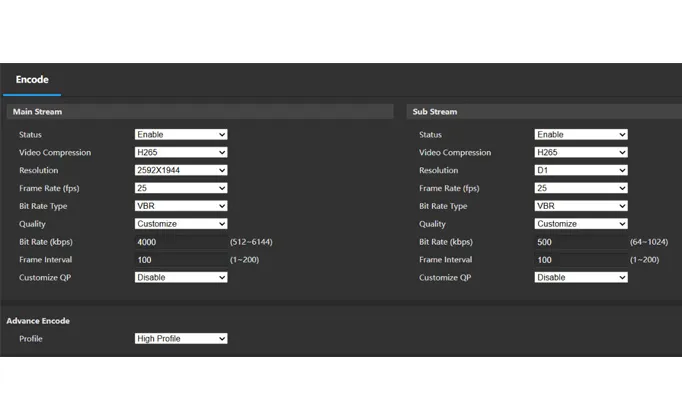
In modern CCTV surveillance systems, main stream and sub stream are two key concepts that often confuse users. When designing a video surveillance project or calculating storage requirements, it is important to understand the differences between the two streams. This article, provided by Ziwin, explains their functions, highlights typical applications, and provides a practical formula to quickly estimate CCTV storage capacity.
What Is the Main Stream?
The main stream is the primary, high-quality video stream generated by the camera.
Resolution: Usually the highest resolution supported by the camera (e.g., 1080p, 4MP, or 4K).
Bitrate: Typically between 3-8 Mbps depending on compression format (H.264/H.265) and image quality settings.
Use Case: Recording to NVR/DVR, local storage, high-definition playback, and evidence collection.
What Is the Sub Stream?
The sub stream is a secondary, lower-bitrate video stream designed for bandwidth-friendly applications.
Resolution: Commonly lower, such as CIF, D1, or 720p.
Bitrate: Generally between 256 Kbps and 1 Mbps.
Use Case: Remote viewing on mobile devices, live preview in multi-screen monitoring, low-bandwidth transmission.
In simple terms:
Main Stream = High-quality storage
Sub Stream = Smooth remote viewing
Why Do CCTV Systems Use Dual Streams?
1. Balance Quality and Bandwidth
Main stream ensures clear recordings.
Sub stream enables smooth playback over limited internet connections.
2. Reduce Storage Pressure
Sub stream requires significantly less storage, suitable for multi-channel preview.
3. Improve System Flexibility
Users can choose between main and sub stream based on their scenario, ensuring both evidence-grade recording and real-time access.
CCTV Storage Calculation Formula
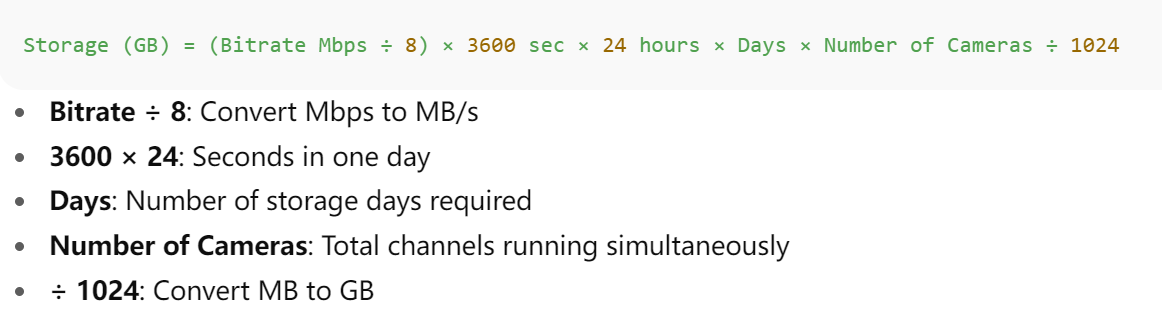
CCTV storage requirements are determined by bitrate, recording time, and CCTV camera.
The basic formula is:
Storage Calculation Example
Scenario:
50 cameras, each 1080p resolution, H.265 encoding, average bitrate 3 Mbps.
Required recording: 90 days.
Calculation:

Result:
For 90 days, about 144 TB is required. Considering real hard drive availability (~90% of nominal capacity), at least 160 TB of storage is recommended.
Storage Optimization Tips
1. Use H.265 Compression
Saves 30–50% storage compared to H.264.
2. Enable Motion Detection Recording
Records only when motion is detected, reducing unnecessary storage.
3. Variable Bitrate (VBR)
Dynamically adjusts bitrate depending on scene complexity.
4. Tiered Storage Strategy
Keep main stream recording for critical cameras, while sub stream recording can be used for general channels.
Conclusion
Main stream and sub stream are essential components of CCTV systems:
Main stream ensures high-quality evidence storage.
Sub stream guarantees smooth remote viewing and efficient bandwidth usage.
By understanding their roles and applying the CCTV storage calculation formula, system designers can plan storage capacity more accurately, reducing costs while maintaining video quality and system reliability.
FAQ: Main Stream vs Sub Stream & CCTV Storage Calculation
Q: What is the difference between main stream and sub stream in CCTV?
A: The main stream provides the highest video quality (e.g., 1080p or 4K) for recording and playback, while the sub stream offers lower resolution and bitrate for smooth remote viewing and reduced bandwidth usage.
Q2: Why is sub stream important in a CCTV system?
A2: The sub stream reduces network load and storage usage, making it ideal for mobile monitoring, multi-screen display, and situations where internet bandwidth is limited.
Q: How do I calculate CCTV storage requirements?
A: You can use the formula:

This helps estimate the total storage capacity needed for your CCTV system.
Q: How much storage do 50 cameras need for 90 days of recording?
A: For 50 cameras at 1080p H.265 encoding (3 Mbps each), about 144 TB is required for 90 days. Considering hard drive efficiency, at least 160 TB is recommended.
Q: How can I reduce CCTV storage space without losing video quality?
A: Use H.265 compression, enable motion detection recording, adopt variable bitrate (VBR), and apply different storage strategies for main stream vs sub stream to optimize storage usage.
 +86-15022658927
  sales@ziwincctv.com
  English
 français
 Deutsch
 Español
 italiano
 русский
 português
 العربية
 tiếng việt
 ไทย
ไทย Türkçe
 Pilipino
 עברי
עברי Afrikaans
 Polska