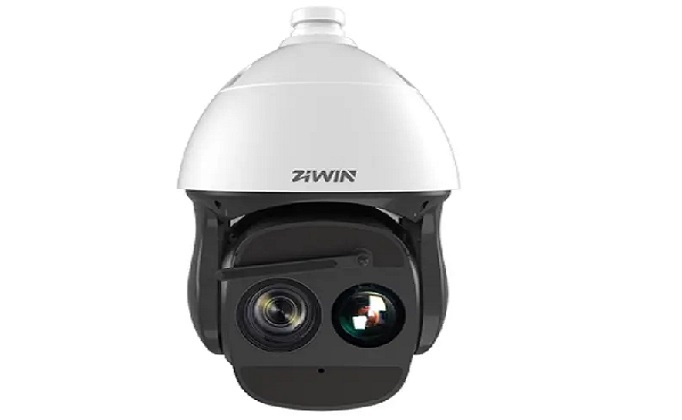
In recent years, the fields of security monitoring have become increasingly familiar with the terms "high definition","network-based" and "intelligent". However, with the rapid development of video surveillance technology, indoor monitoring and daytime surveillance are no longer challenges. The real difficulty lies in outdoor, field-based, night vision, and monitoring in other special environments, where the goal is to improve the clarity and reliability of surveillance cameras. Laser camera, which provides clear visibility over long distances and under challenging conditions, has thus emerged as a critical tool for advancing surveillance technology.
Comparison of Laser Camera with Other Products
| Product Type | Technology Type | Monitoring Range | Applicable Environment | Image Detail Resolution | Remarks |
|---|
| Standard Infrared Camera | Active infrared monitoring | Up to 100 meters | Suitable for environments with insufficient lighting, night surveillance | Clear and visible | Common night vision device, suitable for short-range monitoring, unable to handle pitch-black conditions |
| Laser Camera | Active infrared monitoring | Up to 3000 meters or more | Can be used in total darkness, suitable for long-distance, high-precision monitoring | High precision, high detail | Powerful night vision capability, ideal for large-scale scenes |
| Low Light Night Vision Device | Passive infrared monitoring | Up to 1000 meters | Used in moonlight or other weak light conditions, suitable for short-range monitoring | Can distinguish target shapes but with poor detail | Primarily used in mild night environments, depends on existing weak light sources, suitable for short-range use |
| Infrared Thermal Imager | Passive infrared monitoring | Over 1000 meters | Wide-angle, large-area monitoring, suitable for large open scenes, such as border protection | Unable to discern image details, only outlines can be recognized | Used for detecting target outlines, not suitable for detailed image information, ideal for large-area surveillance |
Advantages of Laser Camera
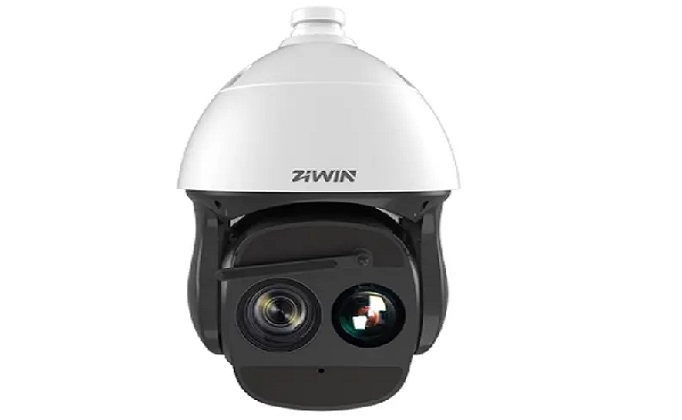
Laser camera is equipped with laser light sources that utilize techniques like uniform light spot enhancement and automatic focusing. These systems offer several key advantages, such as strong light intensity, more uniform imaging, lower power consumption, and longer lifespans.
Compared to standard infrared cameras, laser camera has several distinct features and advantages:
Long Monitoring Range
Laser camera is divided into:
Short-range Laser Camera: Effective night vision range of 100-500 meters.
Medium-range Laser Camera: Effective night vision range of 500-1000 meters.
Long-range Laser Camera: Effective night vision range of 1000-3000 meters.
Automatic Lens Focusing
While infrared cameras can capture images at night, they often struggle to clearly identify faces or details over longer distances. Laser camera, however, utilizes laser infrared components and ultra-low light sensors to capture high-definition night vision images, even in complete darkness. Many laser cameras feature smart functions that adjust the lens' focus automatically based on the distance and speed of moving objects, ensuring high-quality image clarity.
Longer Lifespan
Laser camera has a lifespan three times longer than standard infrared cameras, making it ideal for environments requiring 24/7 monitoring.
Energy-Efficient and Environmentally Friendly
Traditional infrared cameras generate significant heat, consuming a lot of power, which can shorten the lifespan of electronic components due to overheating. Laser camera, on the other hand, does not have this issue, providing more energy-efficient and longer-lasting performance.
Laser Camera Technology Features
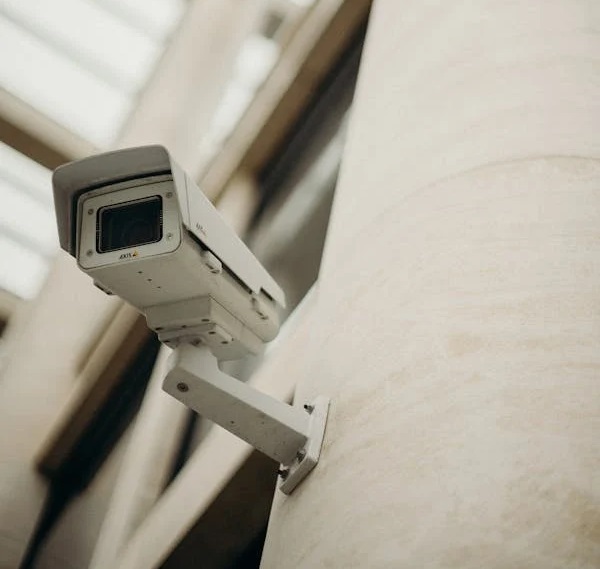
Laser night vision technology has been around for nearly a decade in China and is a form of active infrared night vision technology. The principle behind it is to use a laser point light source and optical diffusion to illuminate the area at night, with wavelengths typically in the range of 808, 940, or 980nm, falling under the near-infrared spectrum. The laser night vision system employs high-light transmission night vision lenses to receive the reflected light from the target and uses low-light CCD cameras to capture and output the image. The illumination system, imaging lenses, and cameras are the core components of this system, and they must work in coordination for the system to deliver optimal results.
The current market includes both integrated and split laser night vision cameras, which use optical, mechanical, and electrical integration technology. These cameras can monitor targets in a range of 100-3000 meters in total darkness and over 3000 meters during daylight.
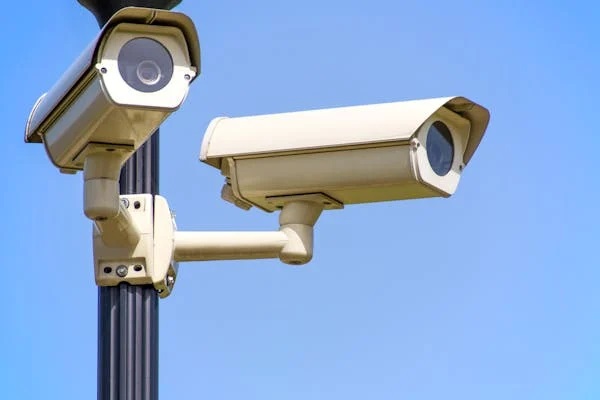
Selecting and Applying Laser Camera
The laser camera's high-power semiconductor laser application technology ensures that the laser's net output power is large enough to achieve the stated monitoring distance. Camera module secondary development optimization technology ensures high image clarity under equivalent lighting conditions. Furthermore, the image's focus adjustment algorithm is optimized to address the issue of slow or repetitive focusing under low light conditions. During zoom operations, the laser's illuminated area automatically fills the screen without requiring manual intervention, though it can be manually adjusted remotely for laser intensity and angle.
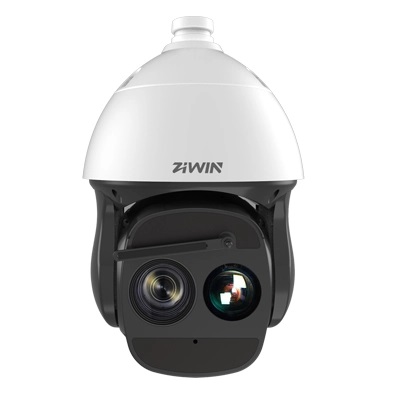
For safety reasons, laser camera must meet national standards for laser power density. The power density is automatically controlled, ensuring that it remains within safe limits while still providing adequate illumination. Additionally, the laser will turn off automatically when it detects the presence of nearby personnel or objects during maintenance checks, ensuring the safety of the maintenance staff.
 +86-15022658927
  sales@ziwincctv.com
  English
 français
 Deutsch
 Español
 italiano
 русский
 português
 العربية
 tiếng việt
 ไทย
ไทย Türkçe
 Pilipino
 עברי
עברי Afrikaans
 Polska