When selecting an industrial pan tilt unit, you must not only compare their maximum load capacities. Many people only choose equipment that can support the weight of their gear, assuming that as long as the total weight does not exceed the upper limit stated in the specifications, it will be sufficient—but the reality is far from that simple. For reliable long-term operation, there are three critical factors to consider besides load capacity: the payload’s center of gravity, what your requirements are for its rotation movements, and what installation method you will adopt. All three directly affect whether the pan-tilt unit can function smoothly, and the load capacity specification alone cannot account for these practical issues that arise during use. Whether you need a 15kg pan tilt, 25kg pan tilt, 35kg pan tilt, or 100kg pan tilt unit, the first step is to sort out the total weight of all equipment to be mounted and the on-site operating conditions. Only after you have a thorough grasp of these most basic conditions should you select a specific model, so that you do not make the wrong choice.
Calculate the Complete Payload First
You must accurately calculate the total weight that the moving component needs to bear; you must not only include the weight of the camera itself. The weights of all accessories that move along with this component must all be added up—the lens mounted to the camera, the housing that encloses the camera, the lighting equipment used for supplementary illumination, the brackets used for fixation, the adapter plate for connecting transfer equipment, and the cables that string all the parts together; the weight of every single item must not be omitted.
For example: if the camera plus the lens weighs 17 kilograms, the housing that holds the camera weighs 4 kilograms, and the brackets and other accessories add another 3 kilograms, adding all these figures together gives a total weight of 24 kilograms that this moving component has to support. If when you select the load-bearing equipment, you only calculate based on the weight of the camera itself and fail to add in the weights of all these accessories, the load-bearing capacity of the equipment you end up choosing will very likely be insufficient—it will not be able to support the entire assembled set of equipment at all, and cannot operate normally.
In addition to the total weight, you must also tell the supplier the length, width, and height dimensions of the entire set of equipment after it is assembled, as well as the specific location where this equipment combination is to be installed. Only after receiving all this information can the supplier calculate whether the position of the center of gravity of the entire set of equipment is accurate, and also confirm that sufficient clearance is reserved around the equipment during movement, so that it will not collide with other objects.
How to Choose Between the Four Payload Classes
15kg Pan Tilt: Check Total Weight and Mounting Space
A 15kg pan tilt is not only suitable for use with equipment whose total weight is just close to 15kg. If your entire set of equipment is lighter, it can also be used as a suitable option. There is only one prerequisite that must be met: the combined weight of all mounted equipment must comply with all rated operating conditions specified for this pan tilt unit’s model.
If you attach a long lens to this set of equipment, or add an extended outer housing, the center of gravity of the entire equipment set may shift away from the pan tilt unit's tilt axis. Even if the total combined weight of all mounted items is still less than 15kg, you cannot confirm suitability based on weight alone. You must still verify two core requirements one by one: first, whether the torque generated by the offset load remains within the pan-tilt unit’s allowable torque limits; second, whether all mounting requirements of this equipment set can match the pan tilt unit's installation specifications. Confirm that both requirements are met before operating the assembled system.
25kg Pan Tilt: A 50kg Upgrade Is Not Always Necessary
If the object to be carried weighs 25 kilograms, the first step is to verify that the candidate pan tilt head you have selected can meet all the requirements. First, it must be adjustable to the angle you need under the actual load; second, it must be able to reach the speed you require when in operation; and finally, it must be compatible with the center of gravity of the object itself. All of these criteria must be met.
If the equipment you have selected has a rated load capacity of exactly 25 kilograms, and it can fully satisfy all the requirements mentioned earlier, then it is sufficient to use this equipment, and there is no need to choose a more expensive model with a higher load capacity. What if the situation changes? For example, if you later need to install additional accessories on this 25-kilogram object, or if the center of gravity of the object deviates from the standard position, or if you have other operational needs in actual use that exceed the capacity of this equipment, then you must reselect a model with a higher load capacity. Even if you do need to upgrade to a higher-capacity unit, you must only make the switch to address a specific practical need; you cannot simply select a model with a larger load capacity number just for the sake of it, which would be a waste of money.
35kg Pan Tilt: Focus on Dynamic Performance
This pan tilt unit with a rated payload capacity of 35kg is worth evaluating if the components you need to carry are heavy, or if you need to assemble a multi-sensor configuration. When selecting it, do not only focus on its marked maximum load capacity. You must install the actual load you intend to use, and practically test several key performance metrics: First, check whether its operating speed can meet the requirements of your project. Second, check whether its start and stop states are stable enough, to avoid occurrences of sudden surges, stuttering, or shaking. Third, you must also test the positioning repeatability to make sure it does not stop slightly off the mark every time, which would affect subsequent use. If your project requires frequent scanning, or needs to run continuously for long periods of time, you must additionally verify its duty cycle and temperature limits—the duty cycle refers to the requirements of how long it can run continuously and how long it must rest, while the temperature limit is the maximum temperature it can withstand during operation, so that it does not overheat and shut down halfway through use. Finally, do not fall into a common misconception: do not assume that a gimbal with a higher load capacity is necessarily better. Being able to carry a heavy load does not mean it has higher precision, nor does it mean it produces less vibration during operation. These two aspects are not necessarily linked to the maximum load capacity. For projects that need wider coverage, a high-precision pan tilt positioner covering 30–100kg payloads is a practical reference range.
100kg Pan Tilt: Assess the Supporting Structure Too
When selecting a 100kg pan tilt, you must not evaluate it by only looking at a single isolated component. You must assess its load capacity, mounting bracket, and the platform that supports the entire set of equipment as a single interconnected system. If any link fails, it could undermine the performance of the whole setup. You need to pay attention to several key factors that affect actual usage results: if the center of gravity of all mounted items is incorrect, the moment of inertia the gimbal has to overcome when rotating with its load is too large; wind during outdoor use creates additional load on the gimbal; or the stiffness of the entire structure is insufficient to support the weight. If any of these issues arise, the gimbal cannot function properly.
If your usage scenario for the gimbal has special requirements, such as needing to maintain its current angle after power loss, or needing to mount it on a constantly vibrating platform, you must not assume it can meet these needs just by checking its core parameters; you have to verify these two capabilities separately. After all, relying solely on the single parameter of "100kg load capacity" is completely insufficient to confirm that this gimbal is suitable for your usage needs, let alone guarantee that it can withstand all special usage scenarios.
Why Can Equal Weights Require Different Units?
As the load’s center of gravity moves farther from the tilt axis, the gravitational torque can increase.
For a 25kg payload under simplified static conditions, an effective perpendicular moment arm of 5cm produces approximately 12.3N·m of torque. Increasing that distance to 15cm raises the torque to approximately 36.8N·m.
Keeping the center of gravity close to the tilt axis can therefore help reduce drive and holding demands. Final selection must also account for acceleration, deceleration, friction, and external loads.
Prepare These Six Details Before Requesting a Quote
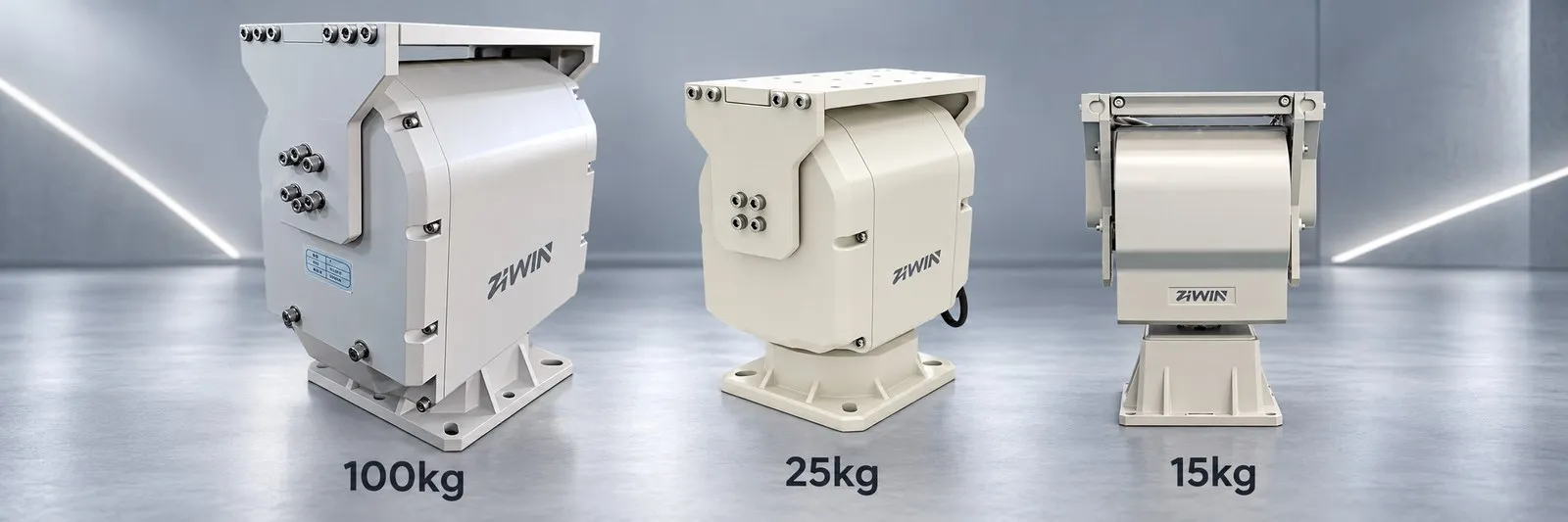
When choosing a pan tilt unit, you must first select a model that is compatible with your complete set of assembled equipment. The pan tilt unit mentioned here is a device that can drive the objects mounted on it to rotate and adjust angles. When selecting one, you cannot make a decision solely based on a single parameter; you must first assemble all the items you plan to mount on the pan tilt unit, and match them based on the actual conditions of this complete set of equipment. Send the details of your complete set of equipment to the pan tilt unit supplier, and they can help you verify three things: first, whether the pan tilt unit's load capacity is sufficient to support the weight of your equipment; second, after installing your equipment, whether the pan tilt unit’s operating status can meet the standard, that is, whether it can rotate normally and achieve its due working state; third, whether the interfaces can be connected properly, that is, whether the docking interfaces of the pan tilt unit and your equipment can match and function normally. This selection method is far more reliable than only asking "what is the maximum weight this pan tilt unit can carry", and you will be more confident in choosing the right model. If you only ask about the single parameter of load-bearing capacity when selecting a pan tilt unit, the basis for your judgment is too weak. By providing the details of your complete set of equipment to the supplier and clarifying these three points, your basis for selecting a pan tilt unit will be sufficient, and your choice will be much more secure.
 +86-15022658927
  sales@ziwincctv.com
  English
 français
 Deutsch
 Español
 italiano
 русский
 português
 العربية
 tiếng việt
 ไทย
ไทย Türkçe
 Pilipino
 עברי
עברי Afrikaans
 Polska