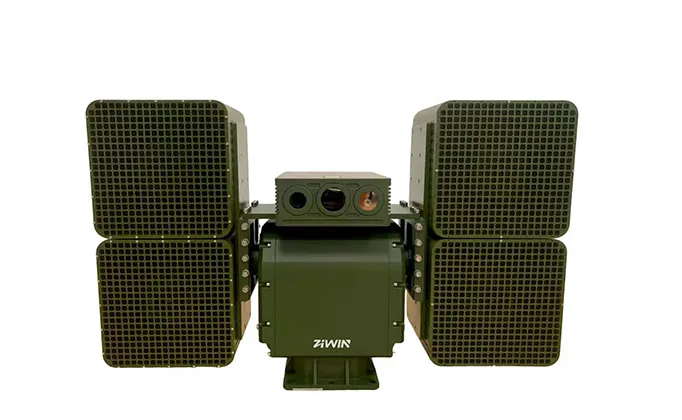
A pan tilt unit (PTU) is a motor-driven support platform that enables mounted equipment to rotate horizontally and tilt vertically.
Pan tilt units is widely used to support and control the direction of surveillance cameras, radar systems, antennas, and heavy-duty loudspeakers. As technology has advanced, their applications have expanded from camera mounting and analog and network signal transmission to high-frequency radio-frequency (RF) signal transmission and high-power electrical supply to mounted payloads.
Base one load ability, control speed, positioning accuracy, and operating environment, pan-tilt units are available in light-duty, medium-duty, and heavy-duty configurations, as well as low-speed, high-speed, and high-precision models, to meet equipment mounting and movement control requirements in different applications.
A pan tilt unit consists primarily of a mechanical structure, a motor system, a control system, and auxiliary components. These components work together to meet precise motion control.

The mechanical structure is made from high-strength die-cast aluminum alloy to make sure stability and wind resistance in severe environments. Base on the payload mounting arrangement, pan tilt unit can be classified as top-mounted or side-mounted (T-type or U-type). Top-mounted designs have a simple structure but a higher center of gravity. Side-mounted designs offer greater stability and a lower center of gravity, allowing them to support heavier payloads.
The drive system is central to precise motion control. Common drive mechanisms have different speciality:
Worm gear drive: Offers a high reduction ratio, a compact structure, and strong self-locking ability. It is usually used in heavy-duty and outdoor pan tilt unit to help prevent the payload from slipping downward during a power outage.
Harmonic gear drive: Transmits motion through the elastic deformation of a flexible gear. Its advantages include compact size, low weight, high transmission accuracy, and zero backlash. It is widely used in high-precision and high-speed pan-tilt units.
Conventional gear drive: Features a simple structure and high transmission efficiency. However, it is little effective than a worm gear drive in achieving large reduction ratios and self-locking, and is mostly used in light-duty pan tilt unit.
The control system includes motor drive circuitry, encoders, and a microprocessor. Modern pan tilt unit usually use brushless DC motors with closed-loop control algorithms to provide stepless speed adjustment and precise speed regulation. High-precision absolute position encoders provide real-time angular position feedback, retaining position information by power interruptions so that operation can resume when power is restored.
To meet different application requirements, pan tilt unit is typically equipped with electrical slip rings for signal transmission during continuous 360° rotation, preheating devices for low-temperature environments, and lightning and surge protection circuitry.
Pan tilt units can be classified as light-duty, medium-duty, or heavy-duty based on their maximum payload capacity.
Light-duty pan tilt units: Less than 15kg pan tilt. They are suitable for small integrated cameras or fixed-focal-length lenses and offer a compact size and low cost.
Medium-duty pan-tilt units: Less than 35kg pan tilt. They are suitable for medium-sized zoom lenses and protective housings and are the most common type on the market.
Heavy-duty pan-tilt units: Support payloads of 30 kg or more than 100kg pan tilt, They use robust metal structures and high-torque motors and are suitable for big equipment, example for: heavy telephoto lenses, radar systems, and laser rangefinders.
Single-axis units: Provide either 360° pan or tilt. They feature a simple structure and relatively low cost.
Dual-axis units: Provide both pan and tilt, enabling multi directional positioning with 360° horizontal coverage.
Top-mounted pan tilt units: The payload is mounted on the top of pan tilt. This arrangement is compact but has a higher center of gravity and requires greater motor torque.
Side-mounted pan-tilt units: The payload is mounted on either side of the unit in a T-type configuration or centrally in a U-type configuration. The lower center of gravity improves stability and effectively reduces mechanical stress caused by payload offset.
Load capacity is the maximum weight a pan tilt unit can support under rated operating conditions. When choose a pan tilt unit, make sure that both the total payload weight and the center-of-gravity height remain within the specified limits. A safety factor of 1.3–1.5 is generally recommended to prevent motor burnout or structural damage caused by overloading.

Pan tilt’s accuracy also different, and we typically classify it into angular resolution and repeatability. Standard pan tilt usually have an angular resolution of 0.01 degrees, with positioning accuracy within ±0.1 degrees. Also, some high-precision pan tilt offer a repeatability as fine as ±0.01 degrees, enabling them to accurately return to preset positions after rapid movements.
Full-rotation pan tilt units typically provide continuous 360° horizontal rotation. The vertical tilt range is generally between −90° and +90°, base on the model. About rotational speed, pan tilt unit with worm gear drives typically operate at lower speeds, but those with harmonic drives or direct-drive motors offer higher speeds. Some units can reach 200°/s or more. Combined with stepless speed control, these units can rapidly track moving object. Positioning accuracy also is a key measure of pan-tilt control precision and primarily includes angular resolution and repeat positioning accuracy.
In conclusion, pan tilt unit is payload platform, it can make sure adjustment, positioning, tracking. when we choose pan tilt unit, a comprehensive assessment should take into account the payload’s dimensions, weight, center-of-gravity height, mounting method, rotational speed, range of rotation, and operating environment.
 +86-15022658927
  sales@ziwincctv.com
  English
 français
 Deutsch
 Español
 italiano
 русский
 português
 العربية
 tiếng việt
 ไทย
ไทย Türkçe
 Pilipino
 עברי
עברי Afrikaans
 Polska