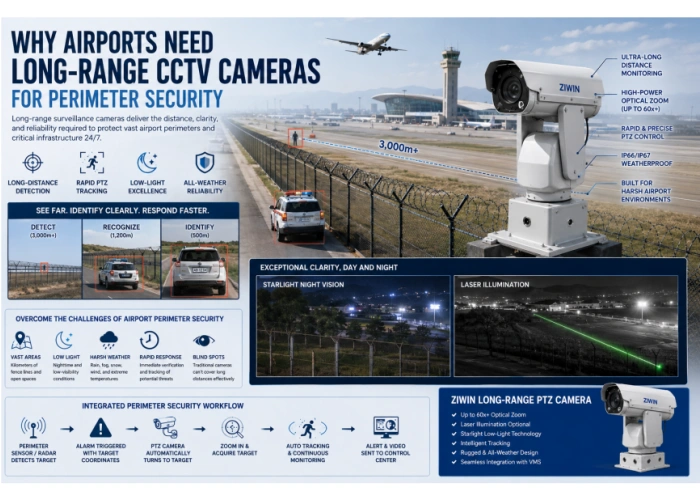
An airport's perimeter is often its most vulnerable asset. Stretching for kilometers—sometimes tens of kilometers—airport fence lines and runways are incredibly difficult to secure using standard surveillance methods. To prevent runway incursions, illegal fence breaches, and unauthorized access, relying on conventional cameras is no longer sufficient. This is where high-performance long range surveillance cameras become the critical backbone of modern airport perimeter security.
The Unique Challenges of Airport Perimeter Security
Securing an aviation facility presents a unique set of geographical and environmental challenges.
Vast Distances & Blind Spots: Standard security cameras only offer effective monitoring within a few hundred meters. For an airport perimeter stretching across massive open fields, this leaves dangerous blind spots.
Poor Lighting Conditions: Runways, aprons, and outer fence lines often lack adequate illumination at night.
The "Can't See, Can't Catch" Problem: When a standard camera detects movement in the distance, the pixelated image is often useless for identifying whether the threat is a human intruder, a vehicle, or just wildlife.
Why Long-Range Surveillance Cameras Are the Solution
To build an impenetrable perimeter, airports require specialized equipment designed for extreme distances and rapid response.
High-Power Optical Zoom (40x, 60x, and Beyond)
The core advantage of an airport perimeter camera is its optical capability. Equipped with 40x, 60x, or even higher optical zoom lenses, a long range PTZ camera can accurately identify a vehicle's license plate or a suspect's facial features from several kilometers away. This allows security personnel to assess threats long before they reach restricted zones.
Rapid PTZ Response for Target Tracking
When perimeter sensors or ground radar systems trigger an alarm, time is of the essence. A high-quality long-range surveillance system must react in milliseconds. Leveraging ZIWIN's advanced heavy-duty pan-tilt technology, these cameras can instantly lock onto the exact coordinates of the alarm and continuously track the moving target across the apron or runway, ensuring the intruder never leaves the frame.
Laser Illumination and Starlight Technology
To combat the low-light challenges of airport perimeters, modern long-range cameras utilize Starlight sensors paired with synchronized laser illuminators. This ensures crisp, clear, and high-contrast imaging even in total darkness, providing 24/7 uninterrupted surveillance for the most critical areas.
Best Practices: Deploying Cameras Along the Airport Fence Line
Deploying cameras in an aviation environment goes beyond just optics; the physical build quality of the hardware is paramount. When selecting a system, consultants and integrators must consider:
Wind Resistance: High-power zoom lenses are highly susceptible to wind shake. A robust, heavy-duty pan-tilt mechanism is required to keep the image stable at 60x zoom during strong crosswinds.
Vibration Resistance: Constant aircraft takeoffs and landings generate severe ground vibrations. The camera housing and motors must be industrial-grade to prevent long-term mechanical failure.
Anti-Corrosion: For coastal airports or areas with harsh climates, an IP67-rated, anti-corrosion housing is mandatory to ensure a long operational lifespan.
Conclusion
When it comes to airport perimeters, if you can't see far, you can't protect effectively. Upgrading to heavy-duty, long-range systems ensures your security team transitions from passive observation to proactive defense. (Note: For areas plagued by heavy fog or extreme weather, pairing long-range optical cameras with thermal imaging creates an even stronger barrier—stay tuned for our upcoming guide on thermal perimeter defense.)
Ready to secure your runways and fence lines? Explore ZIWIN's robust Long-Range PTZ Camera solutions or contact our engineering team to request a detailed datasheet for your next airport project.
 +86-15022658927
  sales@ziwincctv.com
  English
 français
 Deutsch
 Español
 italiano
 русский
 português
 العربية
 tiếng việt
 ไทย
ไทย Türkçe
 Pilipino
 עברי
עברי Afrikaans
 Polska