Picture this: You’ve just installed a high-end, heavy-duty PTZ camera for a perimeter security project. During the day, it works flawlessly. But as the sun goes down and the temperature drops to -20°C (-4°F), the camera suddenly goes offline or gets stuck in an endless reboot loop.
If this sounds familiar, you are not alone. As one of the professional CCTV camera manufacturers, we see system integrators fall into this trap all the time. The culprit? The PoE power budget.
In this guide, we will break down why standard PoE+ is often not enough for extreme cold deployments and how you can ensure your PTZ cameras stay online when you need them most.
The Illusion of PoE+ (802.3at) in Winter
Most modern IP cameras are powered via Power over Ethernet (PoE). The standard PoE+ (IEEE 802.3at) provides up to 30W of power from the switch, with about 25.5W available at the camera after cable loss.
For a standard fixed IP camera, 25.5W is more than enough. However, a heavy-duty PTZ camera in extreme cold is a completely different beast. When the temperature drops, the camera must rely on its internal heater to prevent the lens from freezing and the mechanical gears from locking up.
Let's Do the Math: Where Do the Watts Go?
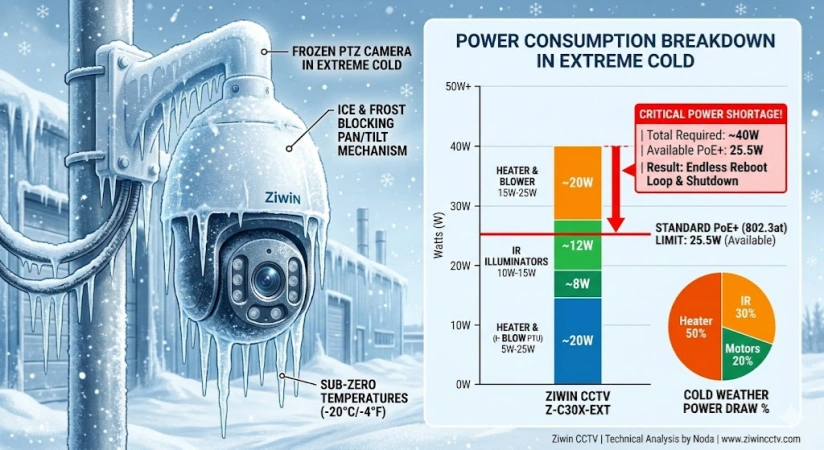
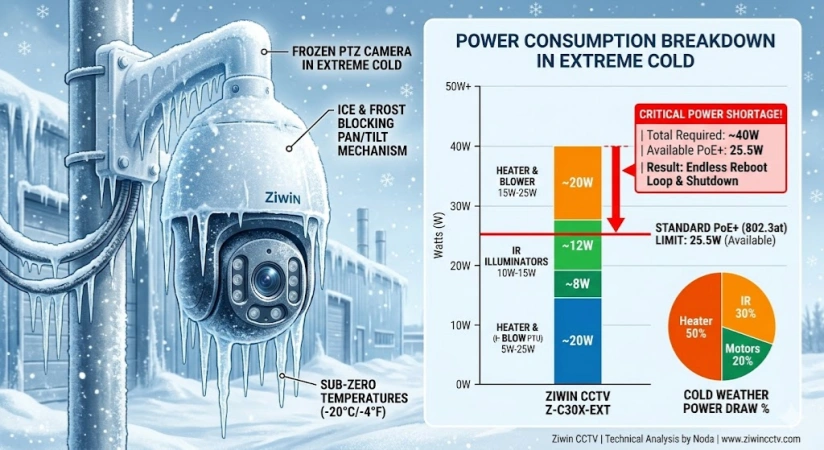
To understand why a PTZ camera reboots, let's look at a typical power consumption breakdown during a winter night:
Core Camera Operations (Image sensor, CPU, Network): ~8W to 10W
Pan & Tilt Motors (Moving the heavy-duty unit): ~5W to 10W
Long-Range IR Illuminators (Turning on at night): ~10W to 15W
Internal Heater & Blower (Turning on at sub-zero temps): ~15W to 25W
Total Peak Power Draw: 38W to 60W+
When the camera tries to draw 40W from a PoE+ switch that can only provide 25.5W, the switch's over-current protection kicks in, temporarily cutting power. The camera dies, the switch resets the port, the camera boots up again, tries to turn on the heater and IR simultaneously, and crashes again. This creates the infamous "winter reboot loop."
3 Proven Solutions for Sub-Zero PTZ Deployments
If you are deploying cameras in regions with harsh winters, you need to rethink your power strategy. Here are the three most reliable solutions:
Upgrade to PoE++ (IEEE 802.3bt) or High-PoE
If you want to stick with a single-cable installation, standard PoE+ won't cut it. You need to use PoE++ (802.3bt), which can deliver up to 60W (Type 3) or 90W (Type 4).
Utilize Traditional 24V AC Power Supplies
For truly heavy-duty pan-tilt units or long-range laser PTZ cameras, 24V AC is still the king of reliability. Unlike DC voltage, AC power travels much better over long distances with less voltage drop. It provides the raw, uninterrupted wattage needed to power heavy motors, long-range IR, and robust heating elements simultaneously.
Implement Sequential Boot-Up (Firmware Settings)
Some advanced PTZ cameras allow for power management in their web interface. You can set the camera to prioritize the heater first. Once the internal temperature reaches a safe operating level, it will then allow the motors and IR to engage. While this doesn't solve a severe power deficit, it can prevent the initial boot-up crash.
Conclusion
When deploying security systems in freezing environments, never underestimate the power consumption of internal heaters and IR arrays. Always calculate your maximum peak power draw, not just the daytime average. By stepping up to PoE++ or utilizing 24V AC, you can eliminate winter downtime and reduce costly maintenance truck rolls.
 +86-15022658927
  sales@ziwincctv.com
  English
 français
 Deutsch
 Español
 italiano
 русский
 português
 العربية
 tiếng việt
 ไทย
ไทย Türkçe
 Pilipino
 עברי
עברי Afrikaans
 Polska